
Mines Plus + Demo Slot
Casinos Where You Can Play Mines Plus +




Similiar Games to Mines Plus +











More Games from Provider Pragmatic Play








Mines+ Game Review
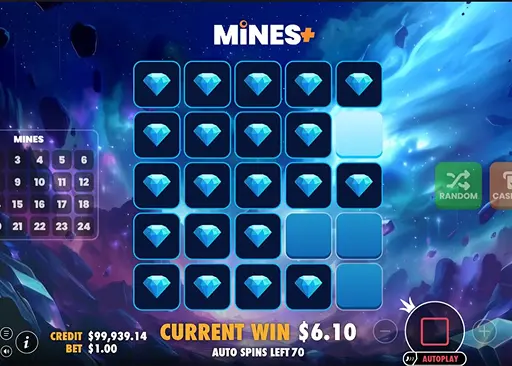
Mines+ represents a modern adaptation of the classic Minesweeper concept, transforming it into a casino game where strategy meets chance on a customizable grid. Players navigate a field of hidden cells, each containing either rewarding gems or devastating mines, with every decision directly influencing potential payouts. The game strips away traditional slot machine mechanics in favor of a pick-and-click reveal system that puts control firmly in the player's hands. Multiple providers have released their interpretations of this format, including BetFury, Hacksaw Gaming, and Spribe, each bringing unique specifications to the table. The Mines slot demo options available across platforms allow newcomers to practice grid navigation and cash-out timing without financial commitment. Unlike conventional free slot machines with predetermined paylines, this grid-based online game rewards calculated risk-taking and immediate decision-making. With RTP figures reaching up to 99.02% on certain versions and maximum wins stretching to $300,000 for VIP players, the stakes can climb considerably. The typical 5x5 grid layout serves as the standard battlefield, though variations ranging from compact 3x3 grids to expansive 9x9 fields exist across different provider editions.
Overview of Mines+ Gameplay Mechanics
At its core, Mines operates on a deceptively simple premise: select cells on a grid to reveal what lies beneath while avoiding randomly placed mines that immediately end your round. Before each game begins, players configure three critical parameters that shape their entire experience. First comes stake selection, ranging from microscopic $0.00000001 minimum bets on BetFury editions to hefty $7,000 maximum wagers, with VIP accounts pushing that ceiling to $21,000. Second, grid size selection offers flexibility between compact layouts and sprawling fields depending on provider. Third, mine count determination allows players to calibrate their risk tolerance by choosing how many bombs populate the grid, with BetFury's 5x5 implementation supporting anywhere from 1 to 24 mines across 25 cells. Each revealed gem increases the active multiplier progressively, building potential winnings with every safe click. The cash-out button remains available throughout the round, giving players complete authority over when to lock in their gains or push deeper into danger.
The absence of spinning reels fundamentally changes the pacing compared to traditional slot machines. No algorithms decide outcomes milliseconds before symbols appear; instead, mine placement is randomized at round start, and player choices determine which cells get exposed and in what sequence. Hacksaw Gaming's version, released in 2022, exemplifies this approach with adjustable grids spanning 3x3, 5x5, 7x7, and 9x9 configurations. Fast mode features across multiple providers accelerate the reveal animations, catering to players who prefer rapid-fire sessions over deliberate contemplation. Mobile optimization ensures the game translates smoothly to touchscreen devices, where tapping cells feels more intuitive than desktop clicking. Provably fair mechanisms in select editions allow technically savvy players to verify the randomness of mine placement through cryptographic verification, adding a transparency layer rarely found in conventional casino offerings.
Mining Theme and Visual Storyline
The mining motif provides the aesthetic backbone across all major versions of this online game, though providers interpret the concept with varying degrees of theatricality. Dark underground environments dominate the visual palette, with shadowy caverns serving as backdrops for grids studded with glittering diamonds and ominous explosive devices. The thematic coherence remains surface-level rather than narrative-driven; no storyline unfolds as players progress, no characters guide the action, no quest objectives emerge beyond accumulating winnings. Instead, the theme functions as atmospheric dressing for the mathematical core, establishing immediate visual communication about risks and rewards. Bombs and mines signal danger through universally recognized imagery, while precious gems and diamonds represent safe progression and mounting profits.
Hacksaw Gaming's implementation leans into darker visual tones, creating an environment that feels more foreboding and tension-filled with each reveal. The graphics engine across providers relies on in-house development rather than licensed third-party assets, resulting in distinct visual personalities despite shared thematic foundations. Grid cells typically present as uniform tiles before interaction, maintaining suspense until the moment of revelation. Explosion animations accompany mine hits, providing immediate visual feedback for round-ending mistakes, while sparkling effects celebrate successful gem discoveries. The absence of elaborate cutscenes or bonus animations keeps attention focused on the core mechanic rather than distracting with tangential spectacle. This streamlined visual approach serves the game's quick-decision gameplay loop, where clarity and speed matter more than cinematic flourish.
Graphics Sound Effects and Animation Quality
Visual fidelity varies considerably between provider implementations, though all versions prioritize functional clarity over photorealistic rendering. The grid interface maintains clean lines and high contrast to ensure instant readability across device sizes, from desktop monitors to smartphone screens. Cell states require immediate visual distinction: unrevealed, gem-containing, and mine-holding tiles must communicate their status at a glance. Color coding typically handles this assignment, with neutral tones for hidden cells, bright gemstone hues for wins, and warning reds or blacks for explosives. Animation frame rates adjust through fast mode toggles, letting players choose between dramatic reveals with full motion sequences or nearly instantaneous results that prioritize throughput over presentation.
Sound design follows a minimalist philosophy, providing audio cues for key moments without overwhelming the experience. Click sounds confirm cell selections, chime effects accompany gem reveals, and sharper tones or brief explosions signal mine hits. Customizable sound controls appear across multiple versions, acknowledging that audio preferences vary wildly among players. Some sessions benefit from full auditory feedback, creating an immersive sensory environment where every click carries weight. Other players prefer muted gameplay, especially during extended sessions or mobile play in public spaces. Animation quality scales with device capabilities, with mobile versions sometimes reducing particle effects or transition complexity to maintain smooth performance on less powerful hardware. The technical implementation leans toward HTML5 frameworks that ensure cross-platform compatibility without requiring dedicated app downloads, though specific platform details remain unconfirmed in available documentation.
Step by Step Mines+ Playing Guide
Launching a Mines session begins with fundamental configuration choices that establish the mathematical framework for the entire round. The betting interface presents stake selection as the first decision point, where players input their wager amount within the permitted range for their account tier. BetFury's extraordinarily wide betting spectrum accommodates both casual penny players and high-rolling VIP accounts, while Hacksaw Gaming's £0.20 to £1,000 range targets a more concentrated middle-market demographic. Once stake gets locked in, grid size selection appears on providers offering variable layouts. Opting for smaller grids like 3x3 creates faster, more volatile sessions with fewer total decisions, while expansive 9x9 grids extend gameplay across dozens of reveals with more gradual multiplier accumulation.
Mine count configuration completes the pre-round setup, directly controlling both potential payouts and survival probability. Choosing just one or two mines across a 5x5 grid creates a relatively safe environment where most cells contain rewarding gems, though multiplier growth per reveal remains modest. Loading the same grid with 20 or more mines transforms the game into a high-stakes gauntlet where each safe reveal dramatically boosts the multiplier but the next click might trigger disaster. After parameters lock in, the play field activates and the reveal phase begins. Players click or tap individual cells in any sequence they choose, with no forced patterns or predetermined paths. Each successful gem discovery updates the current multiplier and potential payout display, while the cash-out button remains perpetually available as an exit option.
Core Gameplay and Grid Reveal System
The reveal mechanic operates on a straightforward input-output loop: select a cell, the game instantly processes whether that position contains a gem or mine, and the result appears with accompanying animation. Unlike slot machines where outcomes get determined before reels stop spinning, mine positions are fixed at round start but remain truly hidden until revealed. This creates genuine player agency rather than the illusion of control found in many casino games. Progressive multipliers constitute the reward structure, with each gem discovery adding incremental value to the active payout calculation. The exact multiplier schedule varies by provider and depends on grid size plus mine count, following mathematical tables that balance house edge against player appeal.
Strategic depth emerges from the tension between pushing for higher multipliers and securing existing gains. Early reveals on mine-heavy grids carry lower individual risk since most cells remain available, but the multiplier starts at base levels. Continuing deeper into a round with fewer unexplored cells concentrates the remaining mines into a shrinking pool, dramatically increasing danger but also pushing the multiplier to lucrative heights. Fast mode toggles alter only the presentation speed, not the underlying mathematics or mine placement. Players racing through dozens of rounds per hour can eliminate animation delays, while those favoring methodical analysis keep full visual feedback enabled. Demo modes on participating platforms replicate the complete gameplay experience using virtual currency, providing risk-free laboratories for testing different mine-count strategies and cash-out timing approaches.
Available Features and Player Controls
The control interface strips away complexity in favor of immediate accessibility. Beyond initial bet, grid, and mine selections, the active gameplay phase offers just two primary actions: reveal another cell or cash out immediately. This binary decision structure creates intense focus on risk assessment rather than distraction through feature-trigger hunting. No scatter symbols require tracking, no bonus wheel awaits activation, no free spins mode lurks several reveals away. Every click either advances the multiplier or ends the round, with no intermediate states or consolation prizes. Customization options concentrate on presentation variables rather than mechanical alterations. Animation speed toggles through fast mode represent the most impactful adjustment, potentially tripling or quadrupling session throughput for players optimizing hourly action.
Sound control granularity varies by provider, ranging from simple on-off switches to volume sliders and individual effect toggles. Mobile implementations adapt the interface to touchscreen paradigms, enlarging cell targets to prevent misclicks and repositioning control buttons for thumb-friendly access. Provably fair systems in supported versions add verification controls that let players input round identifiers or seed values to cryptographically confirm mine placement followed proper randomization protocols. These transparency features appeal primarily to mathematically inclined audiences who value verifiable fairness over trust-based relationships with operators. The feature set deliberately avoids the sprawling complexity found in modern video slots with their cascading mechanics, expanding reels, and multi-stage bonus rounds, instead doubling down on the core reveal-or-cash decision that defines the entire experience.
Grid Symbols and Multiplier Payout Structure
Visual symbol vocabulary in Mines editions remains remarkably constrained compared to the sprawling icon libraries of traditional slot machines. Two primary symbols carry all gameplay significance: gems or diamonds representing safe reveals that boost multipliers, and bombs or mines that terminate rounds and forfeit accumulated winnings. No wild symbols exist to substitute across paylines, no scatter icons trigger feature modes, no mystery symbols transform into random alternatives. The binary symbol system creates absolute clarity: every cell contains either reward or ruin, with no ambiguous middle ground or conditional outcomes. Gem appearances often incorporate visual variety through different colors or shapes, but these aesthetic variations carry no mechanical significance; a blue diamond functions identically to a red ruby within the game mathematics.
Multiplier payout structures follow algorithmic progressions determined by grid configuration and mine count. The mathematical relationship operates on probability principles: each safe reveal eliminates one potential mine location from the remaining pool, reducing the total cell count while maintaining the same number of hidden mines. This creates progressively worse odds with each successive click, justifying increasingly generous multiplier boosts to compensate for mounting risk. BetFury's 99.02% RTP version achieves that exceptionally high return-to-player figure through precise multiplier calibration across thousands of possible grid states. Hacksaw Gaming's approximately 98% RTP remains excellent by casino game standards, representing only a 2% house edge compared to the 5-10% typical of many slot machines. The absence of traditional payline structures means no combinations require matching; every gem reveal directly increments the active multiplier according to the predetermined schedule for that specific grid-and-mine configuration.
| Provider | RTP | Min Bet | Max Bet | Max Win |
|---|---|---|---|---|
| BetFury | 99.02% | $0.00000001 | $7,000 ($21,000 VIP) | $100,000 ($300,000 VIP) |
| Hacksaw Gaming | ~98% | £0.20 | £1,000 | Up to 10,000x |
| Spribe | Not specified | Not specified | Not specified | Up to 10,000x |
Winning Strategies for Mines+ Slot
Effective Mines play balances mathematical reality with psychological discipline, recognizing that no strategy can overcome house edge in the long run while acknowledging that informed approaches optimize short-term variance. The fundamental strategic lever available to players involves mine count selection, which directly determines both volatility and base probability. Configuring a 5x5 grid with only three mines creates a relatively low-volatility environment where most rounds produce modest profits if players cash out after revealing five to ten gems. This conservative approach suits bankroll preservation and steady grinding sessions, trading explosive win potential for higher success frequency. Conversely, loading 20 mines onto the same 25-cell grid transforms the game into a high-volatility lottery where survival past three or four reveals becomes statistically challenging but multiplier growth accelerates dramatically.
Timing decisions around cash-out represent the second major strategic dimension, though emotional control often matters more than mathematical precision here. The optimal cash-out point theoretically arrives when the expected value of revealing another cell equals the current guaranteed payout, but calculating that threshold mid-round requires mental arithmetic most players won't perform. Practical strategy suggests establishing personal rules before sessions begin: perhaps always cashing out after a certain number of safe reveals, or setting a target multiplier that triggers immediate exit regardless of remaining cells. These pre-committed frameworks help avoid the common trap of "one more click" syndrome that keeps players revealing cells past rational stopping points. Demo mode practice allows consequence-free experimentation with different mine counts and cash-out timing, building intuition about multiplier progression rates and survival probabilities without bleeding real currency during the learning curve.
Progressive Multiplier Bonus Mechanics
The term "progressive multiplier" in Mines contexts refers to the within-round accumulation of increasing payout factors rather than networked jackpot pools that grow across multiple players. Each gem reveal adds to the active multiplier through calculations based on remaining cell counts and mine distribution probability. Early reveals on most configurations produce small multiplier increases, perhaps 1.1x or 1.2x per safe cell, since the grid still contains many unexplored positions that dilute risk. As the player advances deeper and the cell count shrinks while mine count remains constant, multiplier jumps become more dramatic. A safe reveal on a 5x5 grid with 20 mines might boost the multiplier by 5x or more once only a handful of cells remain, compensating for the acute danger of that reveal.
This mechanic creates a natural escalation of tension and reward that mimics the psychological appeal of bonus rounds in traditional slot machines, but occurs within the main gameplay rather than as a separate mode. No trigger conditions require meeting to access progressive multipliers; they activate automatically with the first gem reveal and continue scaling until the player cashes out or hits a mine. The mathematical implementation varies between providers, with some using simple probability calculations and others incorporating additional balancing factors to achieve target RTP percentages. Understanding that multiplier growth accelerates rather than remaining linear helps players calibrate expectations: the path from 1x to 5x might require eight safe reveals, while climbing from 5x to 25x could take just three more cells under the right grid conditions. This exponential potential explains why players often push past rational stopping points, chasing the dramatic multiplier spikes that appear tantalizingly close with just one or two more reveals.
Cash Out Options and Timing
The cash-out mechanism functions as the only guaranteed profit-realization tool in Mines gameplay, transforming theoretical multipliers into bankroll deposits. Activating the cash-out button immediately ends the round, applies the current multiplier to the initial stake, and credits the resulting amount to the player account. No delays, wagering requirements, or additional conditions apply; the displayed payout becomes available funds instantly. This creates a unique dynamic where players control outcome timing rather than waiting for reels to stop or bonus rounds to complete. The decision carries permanent consequences: cashing out forfeits any potential gains from unrevealed gems, while continuing past the optimal point might hit a mine and zero the entire round.
Timing optimization theoretically requires calculating expected value at each decision point, comparing guaranteed current payout against the probability-weighted average of possible next outcomes. In practice, this demands unrealistic mental computation speed and perfect knowledge of provider-specific multiplier tables. Pragmatic timing strategies focus on achievable goals: targeting specific multiplier thresholds like 5x or 10x regardless of remaining cells, establishing maximum reveal counts that trigger automatic exits, or using percentage-of-bankroll rules where reaching a certain profit level relative to session stake prompts immediate cash-out. Emotional factors heavily influence timing decisions, with the psychological pain of hitting a mine at high multipliers often outweighing the mathematical expectation of pushing further. Players who establish and follow pre-determined cash-out rules before rounds begin consistently outperform those making reactive decisions in the heat of the moment, when cognitive biases and adrenaline cloud judgment.
Maximum Win Potential and Limits
Win ceilings vary dramatically across Mines providers, divided between fixed currency caps and multiplicative limits. BetFury's $100,000 standard maximum win and $300,000 VIP ceiling represent hard currency limits that apply regardless of stake size or multiplier reached. A VIP player wagering the $21,000 maximum bet would need to achieve only a 14.3x multiplier to hit the $300,000 cap, while a micro-stakes player betting $0.01 could theoretically reach a 30,000,000x multiplier before touching the same ceiling. This structure favors smaller bet sizes in terms of multiplicative potential, though the absolute dollar ceiling obviously provides more value to high rollers. Conversely, Hacksaw Gaming and Spribe employ multiplicative caps around 10,000x, which scale proportionally with stake size rather than imposing fixed currency limits.
A £1,000 maximum bet on Hacksaw's version could theoretically return £10,000,000 if the player somehow achieved the 10,000x ceiling, though reaching such extreme multipliers would require extraordinary luck on heavily mined grids. The practical reality sees most winning sessions settling in the 2x to 50x range, with occasional breakout rounds pushing into three-digit multipliers. Maximum win potential connects directly to grid configuration and mine count: sparse mine placement caps multiplier growth since safe reveals carry lower probability compensation, while dense mine fields create theoretical paths to astronomical multipliers that rarely materialize due to the overwhelming likelihood of hitting explosives before reaching them. Players chasing maximum win scenarios should understand that the grid configurations capable of producing 1,000x+ multipliers also carry corresponding failure rates that make such outcomes statistically rare across thousands of attempts.
Return to Player and Volatility Ratings
RTP percentages in Mines editions achieve levels rarely seen in traditional slot machines, with BetFury's 99.02% figure representing merely a 0.98% house edge. This exceptional return rate results from the transparent probability structure and absence of hidden mechanics or bonus round complexities that often inflate house advantages in slots. Hacksaw Gaming's approximately 98% RTP remains outstanding compared to the industry standard 94-96% range typical of video slots. The high RTP figures reflect the game's mathematical simplicity: mine placement follows pure randomization, multiplier schedules are deterministic based on grid state, and no layered feature triggers introduce additional house edge layers. Players should note that RTP represents long-term statistical expectation across millions of rounds rather than guaranteed short-term performance; individual sessions can and do experience variance dramatically above or below these figures.
Volatility assessment becomes more complex in Mines than traditional slots due to player-controlled configuration. The same game engine can produce low, medium, or high volatility experiences depending on mine count selection. A 5x5 grid with two mines creates low volatility: most rounds produce small wins if the player cashes out conservatively, rare rounds hit mines quickly, and the experience feels relatively steady with modest swings. The identical grid loaded with 22 mines becomes extreme high volatility: the vast majority of rounds end in rapid failure, but successful navigation delivers extraordinary multipliers. Spribe's volatility specification as "ranges from low to high depending on number of mines" accurately captures this dynamic adjustability. Players effectively choose their volatility exposure before each round, allowing unprecedented control over risk profile compared to fixed-volatility slot machines.
| Mine Count (5x5 Grid) | Volatility Level | Typical Session Character |
|---|---|---|
| 1-5 mines | Low | Frequent small wins, rare large losses |
| 6-12 mines | Medium | Balanced mix of wins and losses |
| 13-24 mines | High | Many quick losses, occasional big multipliers |
Frequently Asked Questions About Mines+
Mines+ is a grid-based game inspired by Minesweeper. Instead of spinning reels and paylines, you reveal tiles on a grid. Each tile is either a gem (safe) or a mine (instant round loss), and your multiplier grows with each safe reveal.
Many casinos and aggregators offer demo versions that mirror the real game flow using virtual balance. Demo availability depends on the site and your region.
Choose a stake, select a grid size (if the provider supports multiple layouts), then choose how many mines are on the board. After that, you begin clicking tiles to reveal gems while avoiding mines.
Each safe gem increases your live multiplier based on the current grid and mine count. As you reveal more safe tiles, the remaining unrevealed tiles become riskier on average, so the multiplier steps usually accelerate.
The round ends immediately and you lose the stake for that round (and any uncashed winnings). This is why cash-out timing is the core decision in Mines-style games.
Yes. The cash-out button is available throughout the round. When you cash out, the game ends and you lock in the current multiplier applied to your stake.
No. Mine placement is randomized at the start of each round (and some versions are provably fair), so there are no patterns that reliably reveal where mines are.
Volatility is mainly driven by mine count and grid size. Fewer mines means more frequent smaller wins; more mines means many quick losses but much bigger multipliers when you survive.
RTP depends on the provider and configuration. Some versions are listed as high as 99.02%, while others sit closer to around 98% or use different balancing rules. Always check your specific casino version.
Maximum win rules vary by provider: some use fixed currency caps (higher for VIP tiers), others use a max multiplier cap (often around 10,000×). Verify the limit in the game rules on your platform.
Final Thoughts on Mines+ Game
Mines occupies a unique position in the casino game ecosystem, offering player agency and strategic depth uncommon in the heavily automated slot landscape. The absence of traditional slot mechanics like paylines, free spins, and wild symbols might initially disorient players accustomed to those frameworks, but the grid-based reveal system ultimately provides more direct control over risk and reward than any amount of slot feature complexity. The exceptional RTP figures available across providers reflect the game's mathematical transparency, with house edges below 2% representing genuinely competitive odds by casino standards. This positions Mines as potentially attractive to analytically minded players who appreciate understanding exact probability structures rather than navigating opaque bonus round mechanics.
The variable volatility control through mine count selection delivers genuine customization, allowing the same game engine to serve both conservative grinders seeking steady returns and thrill-seeking high rollers chasing massive multipliers. This flexibility explains the format's growing presence across multiple providers, each bringing slight variations to grid options, betting limits, and maximum win structures. For players tired of watching reels spin with no meaningful interaction between activation and outcome, Mines offers an alternative where every click carries weight and immediate consequences. The learning curve remains gentle enough that demo mode practice quickly builds competence, while the skill ceiling around