
How to Read Slot Machine Lines
Written by: Filip Gromovic Reviewed by: Nashon Khamala
Read time: 12 minutes
Slot machine lines — called paylines — are the engine behind every win or loss on the reels. Before you place a single bet, knowing how many lines are active, what direction they run, and how they connect to payout values is the difference between understanding the game and guessing at it. This guide walks through everything: how to read a payline map, how to decode a paytable, and how line count affects your bet size, volatility, and long-term return.
What Are Slot Machine Lines (Paylines)?
A payline is a predetermined path across the reels on which matching symbols must land for a spin to pay out. Symbols landing anywhere else — even three identical icons — will not trigger a win unless they fall on an active payline.
Early mechanical slot machines had a single horizontal payline running through the middle row. Modern video slots can have anywhere from 1 to over 1,024 paylines, running in horizontal, diagonal, zigzag, V-shape, and W-shape configurations. The number and layout of paylines is set by the game developer and disclosed in the paytable before you spin.
How Paylines Determine Wins
After each spin, the game engine checks every active payline from left to right (and in some games, right to left or both directions). If three or more matching symbols appear consecutively along that path — starting from the first reel — the combination pays out according to the paytable. On 3-reel games, wins typically start with two matching symbols. On 5-reel games, three matching symbols is the standard minimum. The payout is calculated by multiplying the winning symbol’s value by your bet per line.
How Many Paylines Do Slot Machines Have?
Classic 3-reel slots typically have 1, 3, or 5 paylines. Standard 5-reel video slots usually offer between 10 and 50. Many modern games use 243 ways to win, 1,024 ways, or Megaways mechanics — these are not traditional paylines but function similarly. The game lobby or information screen will always display the payline count before you load the game.
Types of Slot Machine Paylines
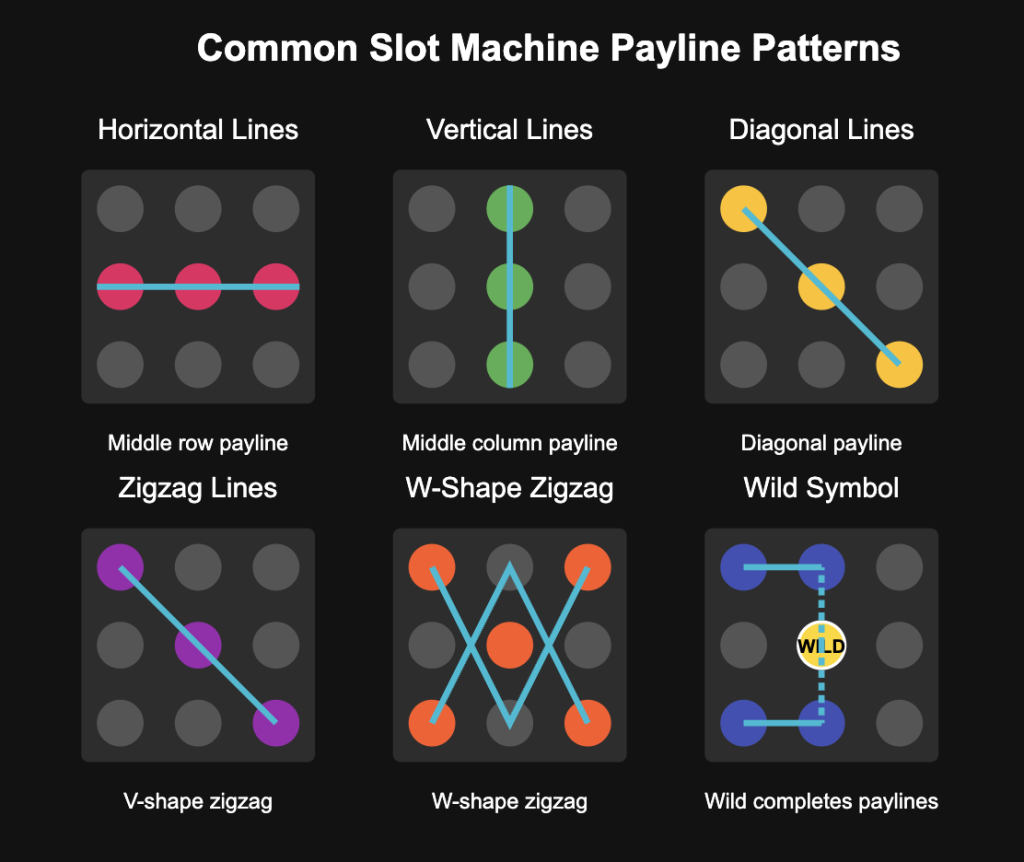
Paylines vary considerably between titles. Understanding each type helps you read the payline map in the paytable and anticipate where winning combinations can form.

Horizontal Paylines
The original payline format and still the most common. Each horizontal line runs from the leftmost reel to the rightmost, with one line per row. A 5×3 reel grid (5 reels, 3 rows) typically starts with 3 horizontal lines — top, middle, and bottom — then adds diagonal and zigzag lines to reach totals of 9, 25, or more. Most games pay horizontally left to right; a smaller number also pay right to left, which the paytable will specify.

Vertical Paylines
Less common and almost exclusive to online slots, vertical paylines pay when matching symbols stack on the same reel — typically three identical symbols on reels one, two, or three. These appear primarily in games using a tall reel format (5×4 or 6×4 grids) where a single reel carries enough symbols to form a vertical combination. If you see a game advertising “stacked symbols,” vertical paylines are often the mechanic being activated.

Diagonal Paylines
Diagonal lines run from a corner symbol on reel one to a corner symbol on the last reel — either top-left to bottom-right, or bottom-left to top-right. A 5×3 grid typically adds two diagonal lines (one for each direction) on top of its horizontal lines. Because a single spin can satisfy both a horizontal and a diagonal payline simultaneously, games with diagonal configurations give players more frequent multi-line wins on the same set of reels.

Zigzag Paylines
Zigzag lines move up and down across the rows as they travel from reel one to the last reel — forming V-shapes, W-shapes, or irregular paths across the grid. These are entirely a software invention and appear in games with 20+ paylines where developers have exhausted the horizontal and diagonal combinations. Each game’s paytable includes a visual map of every zigzag pattern available, which is worth checking before you play a new title for the first time.
Fixed vs. Adjustable Paylines
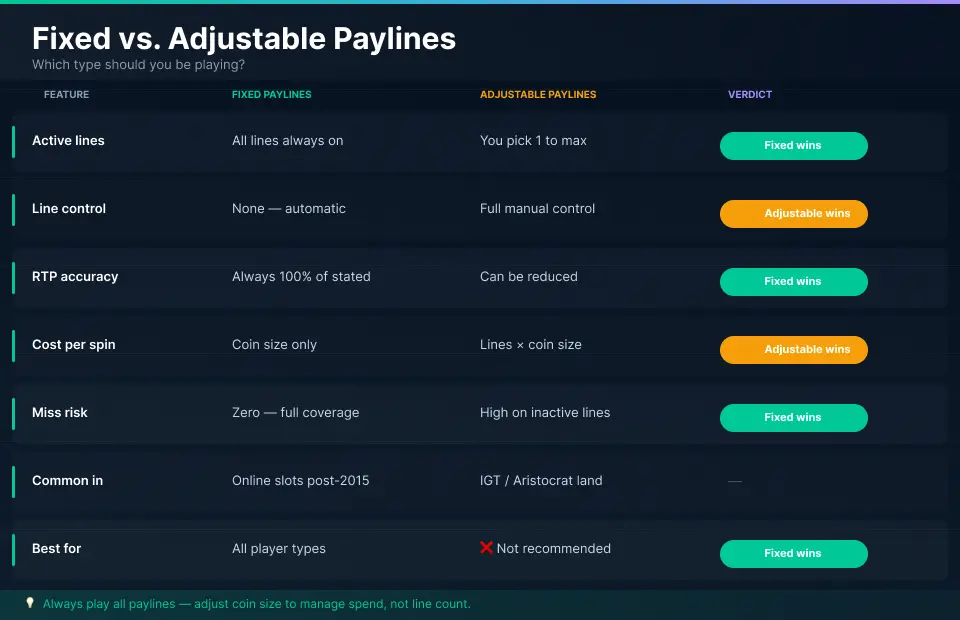
One of the most practically important distinctions in slot machine mechanics is whether a game uses fixed or adjustable paylines. Misunderstanding this affects both how you budget per spin and what RTP figure actually applies to your session.
Fixed Paylines
On fixed-payline slots, every payline is always active — you cannot deselect any of them. Your only control is the coin size or bet level. Most online slots released since 2015 use fixed paylines because developers and regulators prefer the transparency: the RTP percentage published for the game applies to the full set of lines, so players are always playing under the conditions the game was designed for. Examples include the majority of NetEnt and Pragmatic Play titles.
Adjustable Paylines
Adjustable-payline slots let you select how many lines are active before each spin. If a game has 25 paylines and you activate only 10, you pay for 10 lines but can only win on those 10 — a winning combination landing on an inactive line pays nothing. Reducing your active lines lowers cost per spin but also lowers the probability of any given spin producing a return. Adjustable paylines are more common on older IGT and Aristocrat games still found in land-based casinos.
Which Is Better for Players?
Fixed paylines eliminate the risk of missing a winning combination on a deactivated line. For most players, fixed-payline games are simpler and less prone to missed-win frustration. If you are playing an adjustable-payline game on a tight session budget, activating all lines at a lower coin denomination is almost always a better approach than reducing active lines at a higher stake — you preserve full coverage while controlling total spend. Players who also enjoy table games can explore online roulette casinos for a different style of play alongside slots.
How to Read a Slot Machine Paytable
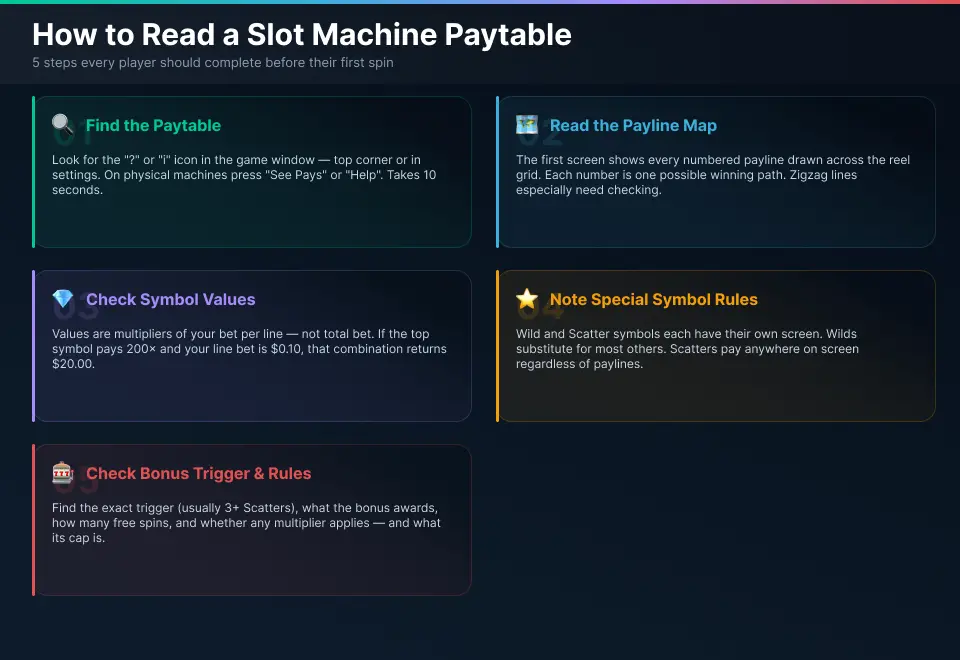
The paytable is the single most useful piece of information available to any slot player — and one of the most consistently ignored. Every licensed slot machine, online or physical, is required to make its paytable accessible. Here is how to read one in practice.
Step 1 — Find the Paytable
On online slots, look for a “?” button, an “i” (information) icon, or a “Paytable” tab usually located in the top corner of the game window or within the settings menu. On physical casino machines, press the “See Pays” or “Help” button. The paytable will open as a series of screens you can scroll through.
Step 2 — Read the Payline Map
The first or second screen of most paytables shows a visual payline map — a diagram of the reel grid with numbered lines drawn across it. Each numbered line is a separate payline. Reviewing this map tells you every possible path a winning combination can take. For zigzag-heavy games with 20+ lines, this map is essential; without it, it is easy to misread which reels contributed to a win and which did not.
Step 3 — Read Symbol Values
Symbol values are displayed as multipliers of your bet per line, not your total bet. The paytable shows each symbol alongside a grid of payouts for landing 2, 3, 4, or 5 of a kind on an active payline. For example, if the golden coin symbol pays 50x for five of a kind and your bet per line is $0.10, landing five golden coins on an active payline returns $5.00. Higher-value symbols typically require more of a kind to pay at all — the paytable will specify the minimum combination for every symbol.
Step 4 — Note Special Symbol Rules
Wild and scatter symbols usually have their own dedicated paytable screen explaining how they behave — whether the wild substitutes for all other symbols or only some, whether landing wilds on a payline pays independently, and exactly how many scatters are needed to trigger the bonus feature. These rules vary significantly between games and are not standardized across developers.
Step 5 — Check the Bonus Rules
If the game has a bonus round, free spins, or jackpot feature, the paytable will explain the trigger condition (usually landing 3+ scatter symbols anywhere on the reels), what the bonus awards, and whether any payline multipliers apply during that mode. Free spins rounds often run at the same or a higher multiplier than the base game — this detail directly affects how valuable the bonus round is and is worth knowing before you decide on your stake size.

Special Symbols and How They Interact With Paylines
Standard symbols only pay when they land on an active payline in a consecutive sequence starting from reel one. Special symbols operate differently — and in some cases, bypass paylines entirely.
Wild Symbols
A wild symbol substitutes for most other standard symbols to complete or extend a payline combination. If you land the top-value symbol on reels one, two, and four, but reel three shows a wild, the game treats it as four of a kind on that payline. Wilds do not typically substitute for scatter symbols or bonus symbols — the paytable will list any exceptions. Some newer games feature expanding wilds (which fill an entire reel), sticky wilds (which hold in place for multiple spins), or multiplier wilds (which double or triple the payline win when involved in the combination).
Scatter Symbols
Scatter symbols are the most payline-independent symbol in slot mechanics. They pay based on how many appear anywhere on the reels after a spin — not on any specific payline. Landing three scatters might pay a small fixed prize; landing three or more typically triggers free spins or a dedicated bonus round. Because scatters are not payline-dependent, they remain active regardless of which lines you have wagered on, even on adjustable-payline games.
Multipliers and Free Spins
Multipliers increase the value of a winning payline combination by a fixed factor — 2x, 3x, 5x, or more. They can be attached to specific symbols, activated during free spins rounds, or accumulate progressively through a bonus game. Free spins are extra spin credits awarded without additional wager cost, running on the same payline structure as the base game unless the paytable specifies otherwise. In some titles, the multiplier climbs with each free spin — understanding the cap for that multiplier is worth checking in the paytable before you decide whether the game’s bonus feature suits your playing style.
Beyond Paylines: Ways to Win, Megaways, and Cluster Pays
Traditional paylines are not the only win mechanic in modern slots. Three alternative systems have become widespread enough that understanding them is now essential for any player exploring online slots.
243 Ways to Win
A “243 ways” game replaces individual paylines with a system that pays whenever the same symbol appears on adjacent reels — regardless of row position. On a standard 5×3 reel grid, that produces 3 × 3 × 3 × 3 × 3 = 243 possible winning combinations. There is no payline map to read and no inactive lines to worry about. The trade-off is that the total bet is always a fixed amount covering all 243 paths. A 1,024-ways variant applies to games with four rows per reel.
Megaways
Megaways is a licensed mechanic developed by Big Time Gaming. Instead of fixed rows, each reel displays a random number of symbols on every spin (typically 2–7 per reel), and the total win ways updates dynamically — reaching up to 117,649 ways on a 6-reel Megaways game. The higher the number of symbols showing on each reel, the more win paths are active that spin. Megaways games do not use a traditional payline map — wins are awarded for matching symbols on consecutive reels from left to right in any position.
Cluster Pays
Cluster-pays games have no paylines at all. Wins are awarded when a specified number of identical symbols (typically 5 or more) form a connected cluster anywhere on the grid, with adjacent meaning touching horizontally or vertically. These games often use a larger grid (7×7 or 8×8) and chain reaction mechanics where winning clusters are removed and new symbols drop in, potentially creating consecutive wins from a single spin.
How Paylines Affect RTP and Volatility
The relationship between paylines, return to player (RTP), and volatility is one of the most misunderstood areas of slot mechanics — and it directly affects how you should choose a game.
What RTP Means in Practice
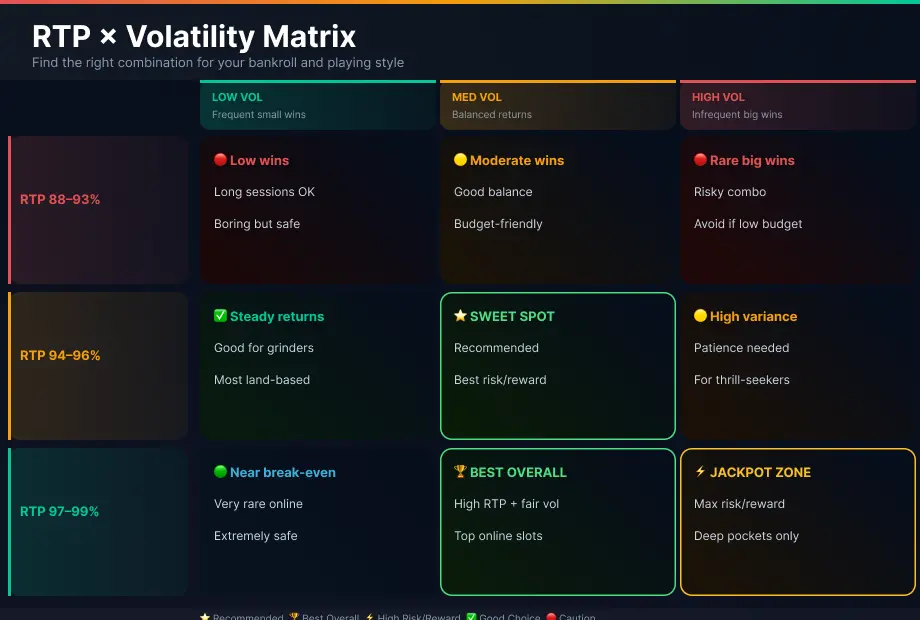
RTP is a theoretical percentage that describes how much of total money wagered a slot pays back to players over a very large number of spins. A slot with 96% RTP returns $96 for every $100 wagered over its statistical lifetime — the remaining $4 is the house edge. This is a long-run mathematical average, not a guarantee for any individual session. On fixed-payline games, the published RTP applies to the full payline set. On adjustable-payline games, deactivating lines can reduce your effective RTP because certain symbol combinations with higher payouts may only appear on lines you have switched off.
Does Activating More Paylines Improve Your Odds?
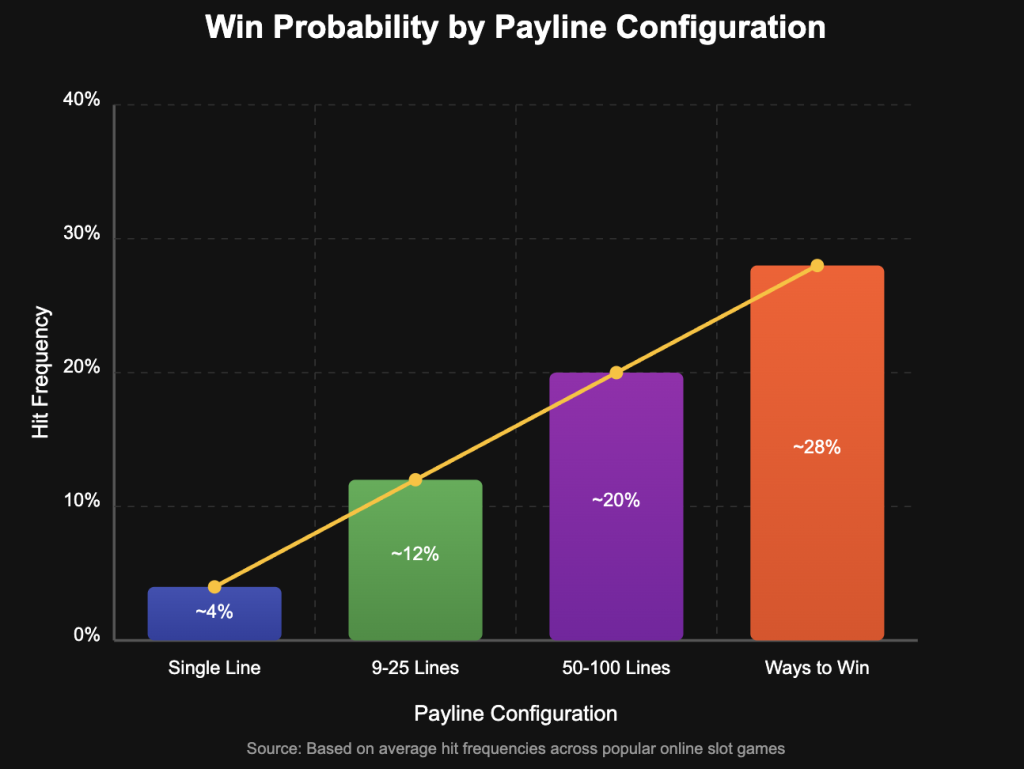
On adjustable-payline games, yes — in a meaningful sense. More active lines means more paths checked per spin, which increases the frequency of any winning combination appearing. However, it also increases your cost per spin proportionally. The RTP percentage does not change with more lines, but the win frequency does. Playing fewer lines at the same total stake is statistically worse because you are concentrating your wager into fewer covered paths at a higher risk of a complete miss.
Volatility and Its Relationship to Paylines
Volatility (also called variance) describes how a slot distributes its returns — not how much it pays in total, but in what pattern. A low-volatility game pays small wins frequently; a high-volatility game pays larger wins infrequently. Payline count is one contributor to volatility: a game with fewer lines concentrates payout potential into fewer paths, which typically increases variance. Games with many lines or ways-to-win mechanics tend toward lower to medium volatility because wins are spread across more possible combinations. The game developer or the paytable information screen will specify the volatility level — this should be a primary filter when choosing between games. For a full breakdown, see our guide on what volatility means in slots.
How to Bet on Paylines
Understanding payline structure is only half the equation. How you structure your bet across those lines has a direct effect on session length, win size, and total risk.

Choosing the Number of Active Lines
On adjustable-payline games, your total bet per spin equals your coin size multiplied by the number of active lines. A game with 25 paylines at $0.04 per line costs $1.00 per spin with all lines active. Reducing to 10 lines cuts the spin cost to $0.40, but leaves 15 paylines uncovered. The better approach for budget-conscious players is to keep all lines active and reduce the coin denomination instead — this preserves full payline coverage at a lower overall cost, which is statistically preferable to leaving lines inactive. Players who prefer Maestro casinos will find this payment method widely supported across reputable platforms.
Bankroll Management by Payline Count
A practical session bankroll rule: your total session budget should cover at least 100 spins at your chosen stake. This gives the game enough spins to reflect its statistical tendencies, including triggering bonus features at their expected frequency. If a game’s bonus round triggers on average every 150 spins, a 50-spin session may never reach it — which skews your session result away from the game’s published RTP. For more detail on managing your stakes, see our guide on how to win at slot machines.

Understanding False Wins
A false win — sometimes called a “losses disguised as wins” or LDW — occurs when a spin triggers a win celebration but the payout is smaller than the amount wagered on that spin. For example: you bet $1.00 across all paylines, land a combination that pays $0.30, and the machine plays a win animation and sound. Technically you lost $0.70 on that spin, but the celebratory response may register as a positive outcome.
False wins are more common on games with many paylines because a higher line count increases the chance of landing at least one small-paying combination per spin — even when the net result is a loss. Research from gambling behaviour studies has found that LDWs activate similar psychological responses to genuine wins, which can contribute to extended play beyond intended limits.
The practical defence is simple: always track your total bet per spin against your total return, not individual payline wins. Most online slot interfaces display a “win” figure that represents the combined payout from all active paylines — compare this against your total stake per spin, not per line.
Tips for Reading Slot Machines Like a Pro
Always open the paytable before your first spin. This takes under 60 seconds and tells you the payline count, line directions, symbol hierarchy, special symbol rules, and bonus trigger conditions. No other single action gives you more pre-spin information.
Check the RTP before loading a game. Most online casino lobbies display RTP in the game information panel. Aim for 95% or above as a baseline for regular play. Check our guide to the best RTP slots for ranked examples with verified figures.
Match volatility to your session budget. High-volatility games require deeper bankrolls because their wins are clustered infrequently. If your session budget is limited, a low-to-medium volatility game with a higher line count will produce more frequent, smaller returns and extend your play session further.
Understand the minimum winning combination per symbol. Some paytables require 3-of-a-kind even for low-value symbols; others pay from 2-of-a-kind. A game that pays from 2-of-a-kind on its base symbols has significantly higher win frequency in the base game, which matters when budgeting your session.
Know the jackpot trade-off. Progressive jackpot slots often carry lower base-game RTP to fund the jackpot pool. If you are not actively targeting the jackpot, that lower RTP applies to every spin you take. Our guide on what triggers a jackpot on a slot machine explains how jackpot mechanics interact with regular gameplay.
Recognize false wins. If the machine is celebrating but your balance went down, you did not win. Track net balance change per session, not the number of spin animations that included a win sound.
Use the slot terminology guide. If you encounter a mechanic or term in a paytable that is unclear, our slot machine terminology guide covers every standard term used across online and physical games.

Responsible Gambling
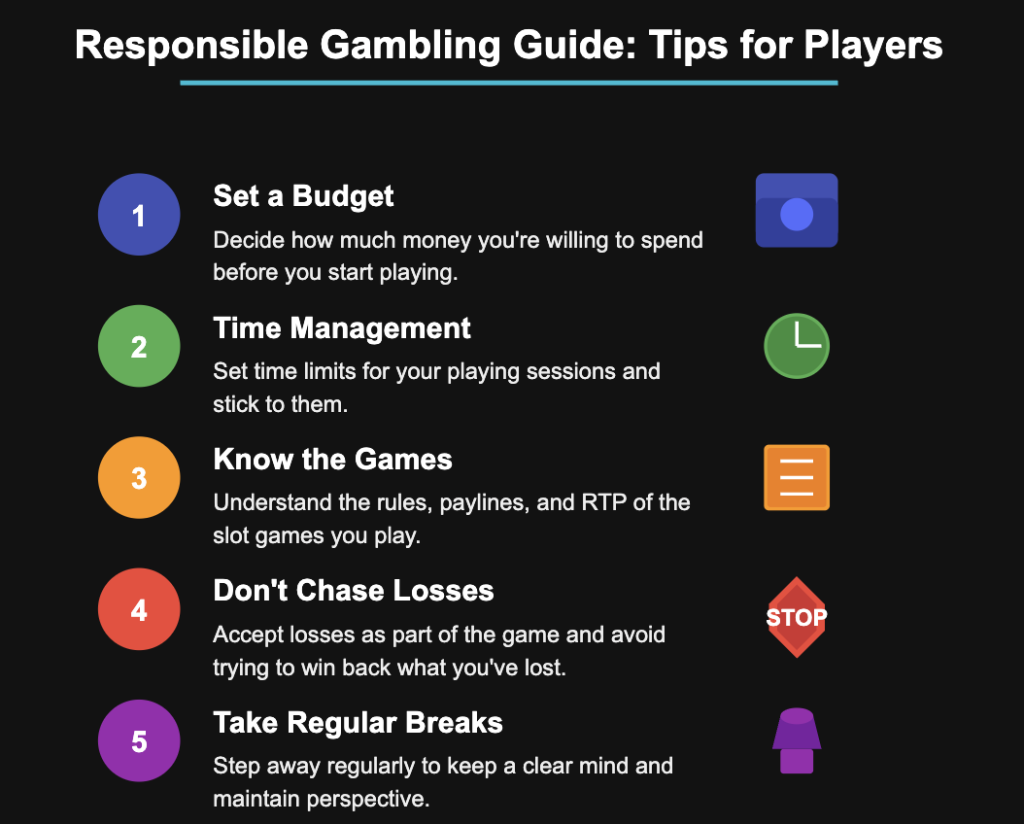
Slot machines are designed to be engaging — payline mechanics, win animations, and sound design all contribute to that. Approaching each session with set limits and clear awareness of how wins are calculated helps keep play within bounds you are comfortable with.
Setting Limits
Decide on a session loss limit and a win target before you open a game, not while you are playing. Reputable online casinos provide deposit limits, session time reminders, and loss limit tools in the account settings — using them removes the need for in-session willpower. Chasing losses after a bad run is the behaviour most associated with sessions that end above budget. For more on the odds of winning on a slot machine, including how to interpret those odds per session, see our dedicated breakdown.
Where to Get Help
If gambling is affecting your finances, relationships, or mental health, the following organisations provide free, confidential support.
Frequently Asked Questions

Filip Gromovic is a senior slots reviewer here at FreeSlots99 with over five years of experience evaluating the latest drops in the world of iGaming.
Being a slot fan himself, Filip approaches slot ratings just the way we like it – professionally, but also from a player’s standpoint.
That enables him to give his unbiased take on the slot’s features, gameplay and design, while only recommending top-tier releases to our readers.
More info on Filip Gromovic



Having served FreeSlots99 for more than 5 years as a senior content editor and reviewer, Nashon Khamala has extensive knowledge in game slots and iGaming.
His membership in the Editorial Freelancers Association helps him deliver content that reaches both editorial excellence standards and an engaging information level.
By using his expertise in slots games combined with player-focused analysis, Nashon delivers a professional evaluation of slot features and player experiences in his reviews.
More info on Nashon Khamala