We have over 28,000 FREE games. Start here.
Written by: Filip Gromovic Reviewed by: Nashon Khamala
Updated: Mar 2026
In 2026, some free online casino offers can still lead to real-money withdrawals, but only in specific circumstances. In the United States, readers need to separate true no deposit casino bonuses from demo-only free play and from sweepstakes-style platforms that use a different legal model. Those categories are often blended together in search results, even though they do not offer the same payout path, legal protections, or withdrawal rules. This guide explains how no deposit casino offers work, which games make the most practical sense, what legal limitations apply, and how to avoid wasting time on offers that look attractive but are hard to cash out.
The basic path remains straightforward: register, verify eligibility, activate the offer, play eligible games, meet the stated bonus conditions, and request a withdrawal if the remaining balance becomes cashable. In practice, however, the result depends on RTP, contribution rates, wagering requirements, maximum cashout limits, time restrictions, identity verification, and the licensing status of the casino itself.
Treat the list above as a starting point, not proof that every title is always eligible everywhere. The exact game you can use with a no deposit bonus depends on the operator, your location, and the live promotional terms on the day you register. The fastest way to narrow the field is to check whether the casino is legal where you are, whether the offer is genuinely no deposit, and whether the selected game contributes fully toward wagering. A smaller bonus with clean terms is often worth more than a larger headline offer with aggressive restrictions.
The best free online casino games win real money no deposit only when three things line up: the game is eligible under the live bonus terms, it contributes efficiently toward wagering, and it is offered by a properly licensed operator or within a clearly defined legal model. Slots usually dominate no deposit play because they most often count fully toward wagering. Table games and video poker can offer stronger theoretical return, but they frequently count at reduced rates, which makes them slower or less practical for bonus conversion.
High RTP slots generally give bonus funds more staying power. RTP is a long-run theoretical return based on a large sample of play, not a guarantee in a single session, but the difference between a 96% slot and a 92% slot still matters. A lower house edge gives your free credits more room to survive long enough to clear wagering requirements.
Low-volatility slots tend to deliver smaller, more frequent wins that can help maintain balance during bonus play. High-volatility slots create the opposite profile: longer dry spells, but a better chance of landing a larger hit that can reach a cashout cap quickly. The right choice depends on your wagering target, your maximum withdrawal limit, and how quickly the bonus expires.
| Slot Title | Provider | Typical RTP | Volatility | Best Use Case |
|---|---|---|---|---|
| Starburst | NetEnt | 96.09% | Low | Steadier bonus clearing |
| Book of Dead | Play’n GO | 96.21% | High | High-upside capped cashout attempts |
| Gonzo’s Quest | NetEnt | 95.97% | Medium | Balanced risk and volatility |
| Mega Joker | NetEnt | Up to 99.00% | Low | Specialized high-RTP strategy play |
| Starmania | NextGen | 97.87% | Low | Low-variance survival play |
| Age of the Gods | Playtech | About 95.02% | Medium | General slot bonus play where eligible |
Mega Joker is statistically powerful on paper, but its format is more specialized and availability varies by market and operator. For steady bonus clearing, lower-volatility titles are often the safer option. For players trying to reach a capped cashout with one stronger result, a higher-volatility slot can make sense, but the bust-out risk is much higher.
Blackjack and roulette can appear in bonus-eligible casino libraries, but they are often weaker tools for clearing no deposit offers than slots. Blackjack variants can offer very high theoretical RTP under strong strategy, while European roulette is materially better than American roulette because of the lower house edge. The trade-off is that many casinos assign table games only partial contribution toward wagering, so progress is often much slower than with slots.
If table games count at a reduced rate, they are best for players who care more about lower house edge than about clearing speed. If the operator excludes them entirely, they should not be part of a no deposit plan at all. Always check the contribution table in the bonus terms before assuming blackjack or roulette will help you complete the offer.
Live dealer titles are common in regulated markets, but they often contribute less than RNG casino games and may be excluded from promotional balances entirely. When bonus clearing is the goal, standard RNG versions are usually more efficient than live tables.
Video poker can offer some of the best theoretical returns in a casino, especially on strong Jacks or Better paytables, but many operators reduce its contribution toward wagering or exclude it altogether from bonus play. If it is allowed, it can be mathematically attractive for careful players, but it typically clears bonus terms more slowly than slots.
Specialty games such as keno, scratch cards, crash-style games, instant-win products, or virtual sports may also appear in casino libraries, but they are often poor choices for no deposit conversion. RTP can vary widely, and bonus contribution is often reduced or set to zero. For most players trying to convert a small bonus into withdrawable funds, mainstream video slots remain the most practical category.
Game selection should be based on three practical factors: the wagering requirement, the maximum cashout, and your appetite for variance. If the wagering target is high and the cashout cap is modest, low-volatility slots usually give you the best chance of staying alive long enough to finish the requirement. If the cap is low and your goal is to hit it quickly, a higher-volatility game may offer more upside, but the chance of losing the bonus before completion rises sharply.
A sensible rule is to match volatility to the structure of the offer rather than to personal preference. Many players fail because they choose games that feel exciting, not games that fit the math of the promotion.
If your goal is survival and steady wagering progress, low-volatility slots are usually the best fit because they tend to stretch a small promotional balance longer. If your goal is reaching a low maximum cashout cap quickly, a medium- or higher-volatility slot can make sense because one stronger hit may get you there faster. If your goal is pure learning or low-house-edge experimentation, blackjack or video poker may feel more appealing, but they are often less efficient for no deposit clearing because contribution rates are commonly reduced.
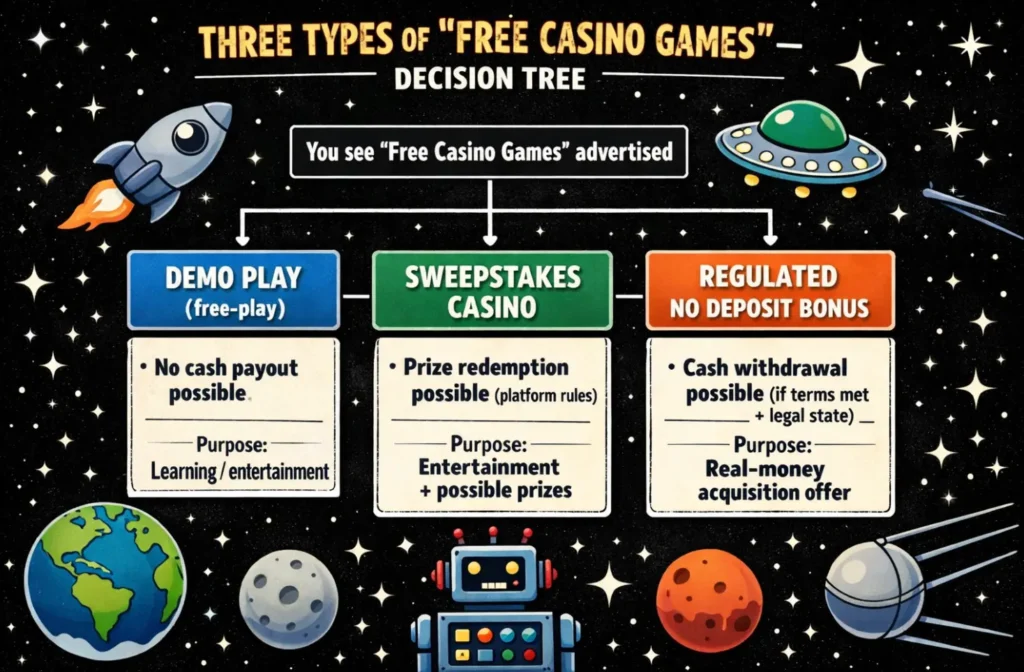
In U.S. gambling content, the phrase “free casino games that pay real money” can describe three very different experiences: a regulated no deposit bonus at a legal online casino, a sweepstakes-style platform using promotional currencies, or a free demo game that does not pay cash at all. These are not interchangeable. If your goal is a standard cash withdrawal from a licensed casino, you need a real-money operator that is legal in your state, a genuine no deposit offer, and terms that allow bonus winnings to convert into cashable funds.
If even one of those points is unclear, the offer should not be treated as one of the best free online casino games win real money no deposit opportunities available to U.S. players.
The legal U.S. online casino market is broader than many older guides still suggest, but it remains fragmented and highly state-specific. A list of “legal states” should always be treated as a working snapshot rather than a permanent rule, because launch status, operator approvals, and market access can change. The most practical habit is to verify the operator itself before registering, rather than relying on a single static state list alone.
This matters because only licensed operators in active regulated states can legally offer standard real-money online casino play under the U.S. model. Outside those jurisdictions, players may instead encounter social casinos, sweepstakes-style platforms, tribal alternatives, or land-based options depending on local law and the product structure being offered.
Pennsylvania, New Jersey, and Michigan remain the most established online casino jurisdictions for many U.S. players because they offer broad operator choice and mature regulatory structures. Connecticut and Delaware are more limited in operator count but still operate within clearly defined frameworks. West Virginia and Rhode Island are smaller markets, yet they remain part of the broader regulated iGaming conversation.
The key point is simple: legal access is determined by the state you are physically located in when you play, not just by your permanent residence. Regulated operators use geolocation tools, and access can be restricted the moment you leave an eligible jurisdiction or cannot verify your location.
Even if an operator is well known nationally, you should still confirm that it is specifically approved for your location and the exact product you want to use. A brand may be live in one state, unavailable in another, or available only for sports betting rather than online casino gaming.
Players outside active regulated casino states may still encounter free-play options, but those alternatives do not all work the same way. Some are social casinos built for entertainment only, while others use a sweepstakes-style promotional model that is legally distinct from state-regulated real-money casino play.

Social casinos usually use virtual currency and are designed for entertainment rather than standard cash withdrawal. Sweepstakes-style sites may use separate promotional currencies that can sometimes be redeemed for prizes, subject to platform rules, state exclusions, and a different legal framework. Because these models differ from regulated iGaming, players should not assume they offer the same protections, game availability, dispute channels, or payout process as a state-licensed online casino.
A trustworthy U.S.-facing casino must be properly licensed where it offers real-money play, publish clear promotional terms, provide visible responsible gambling tools, and make support and banking rules easy to find. Most importantly, players should be able to verify the operator through a regulator, official operator list, or another clearly documented approval framework before they register.
If a platform targets U.S. players for real-money casino gaming but cannot be tied to a legitimate legal structure, it should not be treated as a top-tier option no matter how generous the headline bonus looks. Bonus size is never a substitute for legal clarity and operator transparency.
A legitimate offer may still be restrictive, but it should never be difficult to identify who operates the site, what the bonus requires, and how withdrawals are reviewed.
A no deposit bonus is a customer-acquisition offer that lets a new player try eligible casino games without making an initial deposit, but it is rarely “free money” in the practical sense. The reward usually arrives as restricted bonus value, fixed free spins, or a mixed promotional package. The key detail is that bonus value is not the same as cash balance. In most cases, winnings remain non-cashable until the player completes the required terms.
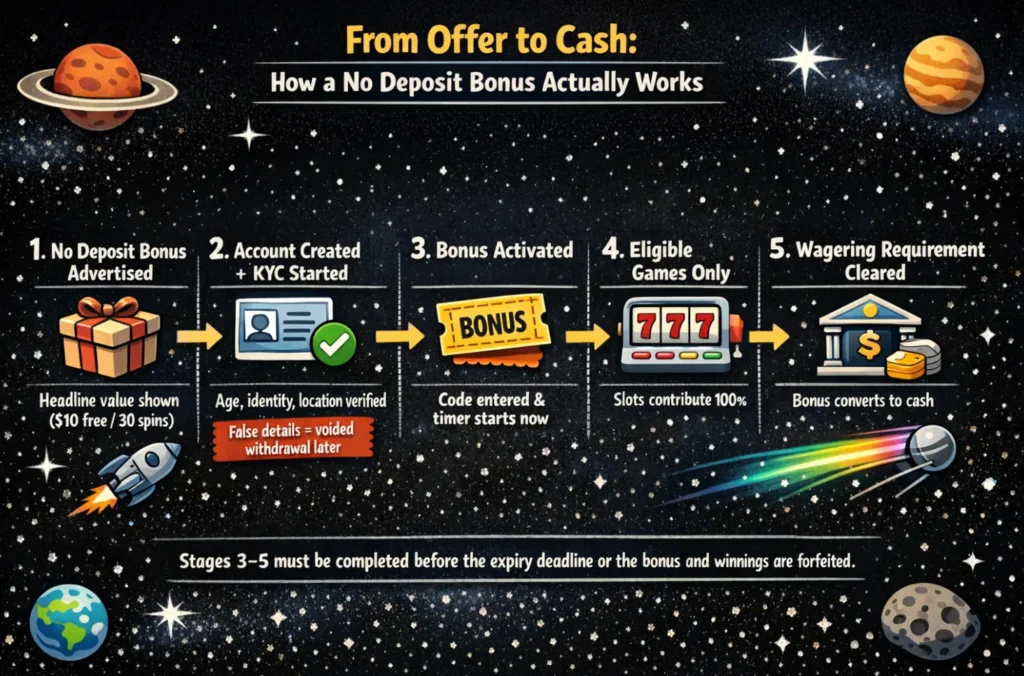
Free spins are usually awarded on one specific slot at a fixed stake. If a player receives 20 or 30 spins, those spins are not cash themselves. Any resulting winnings are usually credited as bonus funds and become subject to wagering rules, cashout limits, and an expiry window.
What matters is not the number of spins alone, but what happens to the winnings from those spins. A small win can still become difficult to withdraw if the terms attach a high wagering requirement or a low maximum cashout cap. That is why a modest but fair offer can be more valuable than a larger one with poor conditions.
Bonus cash is more flexible because it may be usable across multiple eligible games, while free spins are usually locked to one slot. That flexibility can help if the player wants to choose a lower-volatility game or a title with stronger wagering efficiency. At the same time, free spins reduce overbetting risk because the operator fixes the stake in advance.
For most players, the better format depends on the terms. If the casino offers flexible bonus funds with reasonable wagering and broad game eligibility, bonus cash can be stronger. If the cash bonus is heavily restricted and the free spins come with lighter conditions, the spins may have better practical value.
| Format | Can Lead to Cash Withdrawal? | Main Catch | Best For |
|---|---|---|---|
| Regulated no deposit casino bonus | Yes, if terms are completed | Wagering, caps, expiry, game restrictions | Players in legal iGaming states |
| Sweepstakes-style casino | Sometimes, under a promotional redemption model | Different currency system, state exclusions, platform-specific rules | Players outside standard iGaming states who understand the model |
| Demo / free-play casino game | No | Entertainment only | Learning game rules without financial risk |
This distinction matters because many pages use “free casino games” as a catch-all phrase even when the actual product is not a standard regulated online casino bonus. If your goal is a traditional cash withdrawal, only the first category follows the standard no deposit path described in this guide.
Some no deposit bonuses are applied automatically, while others require a bonus code or a manual opt-in step during registration. If a code is required, it should be entered exactly as shown and before any action that could invalidate the offer, such as activating a conflicting promotion or making a deposit tied to another bonus.
Before you start playing, confirm three things: the bonus appears in the account, the correct reward has been credited, and the relevant terms are visible in the bonus section. If any of those details are missing, it is better to pause and confirm with support before placing qualifying bets.
No deposit bonuses are acquisition tools. Casinos use them to lower the barrier to trying the platform, while expecting that only a minority of players will ultimately convert the reward into a successful cash withdrawal. Wagering requirements, contribution limits, caps, and deadlines are designed to control promotional cost while still keeping the offer attractive enough to acquire users.
In return, operators expect accurate registration details, successful age and identity checks, and full compliance with the bonus rules. If the player enters false details, exceeds the maximum permitted bet, or breaks the terms, the casino can void the bonus and related winnings.
Claiming a no deposit casino offer follows the same broad sequence across most legitimate platforms, even though the exact screens and requirements vary by operator. The most important part is not speed, but accuracy: choosing a legal casino, reading the terms, and confirming the offer has been applied correctly before playing.
Start by choosing an operator that is active in your location and clearly fits the legal model you intend to use. Open the current promotions page and read the terms before registering. Check the reward type, expiry period, wagering requirement, maximum cashout, and whether the promotion is restricted to certain games.
Register using accurate personal details. Legitimate operators rely on age checks, identity verification, and geolocation, so incorrect information can become a problem at withdrawal stage even if the bonus appears to work at first. If a code or opt-in is required, complete that step exactly as instructed.
Before you begin playing, confirm that the promotion has been credited correctly and that the system shows the offer as active. If the casino does not clearly display the status of the bonus, it is wise to pause and confirm with support.
Wagering requirements determine how much you must bet before bonus winnings become cashable, subject to all other restrictions. If a bonus carries a 20x or 30x requirement, the balance must survive enough wager volume to meet that threshold. The actual amount of useful progress depends on which games count and at what percentage.
A bonus can look simple at first, but the real cost depends on both the wagering multiplier and the game contribution rate. Here is a quick side-by-side example.
Slots (100% contribution)
Blackjack (10% contribution)
Same bonus, very different real cost.
Once the conditions are met, many platforms convert the remaining eligible balance to cashable funds automatically, though some require the player to request a withdrawal manually. Available payout methods vary by operator and jurisdiction, but common methods include bank transfer, e-wallets, prepaid products, or other approved payment tools.
If a bonus includes a maximum cashout limit, that limit overrides the balance generated from the promotion. A player who finishes wagering with a large balance may still be able to withdraw only the capped amount.
Completing wagering does not guarantee a smooth cashout. Withdrawals often slow down when a player has not completed identity verification, uses payment details that trigger additional review, enters inconsistent account information, or creates a terms check through restricted betting behavior. To reduce avoidable friction, verify your identity early, keep account details accurate, avoid exceeding the maximum bet during bonus play, and confirm that the balance has fully converted from bonus funds to cashable funds before requesting withdrawal.
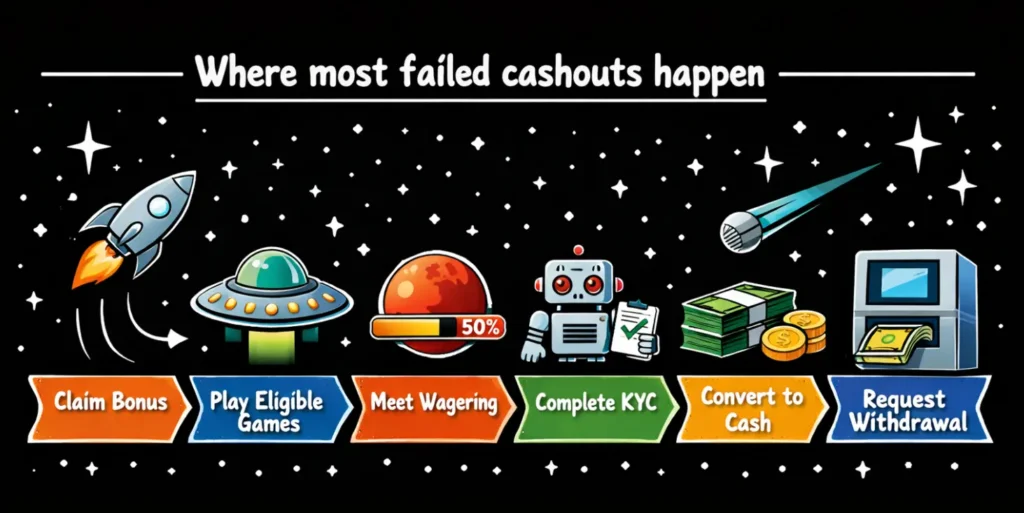
The first mistake is choosing games with poor wagering value. The second is ignoring contribution rates and assuming every dollar wagered counts equally. The third is exceeding the maximum permitted bet during bonus play, which can void the promotion. The fourth is letting the offer expire before wagering is finished. The fifth is misreading the difference between bonus funds and cash balance. The sixth is using inaccurate registration details that fail verification later. The seventh is trying to claim multiple new-player offers in a way that breaches the operator’s rules on duplicate or linked accounts.
The play phase of a no deposit bonus can begin almost immediately, but the withdrawal phase is where delays usually appear. Even after wagering is complete, payment timing can still depend on identity checks, geolocation confirmation, bonus review, and the operator’s own withdrawal queue. The practical way to think about it is simple: bonus activation can be fast, but cashout is usually slower because compliance review matters.
No deposit terms are written to define the exact limits of the offer. The best way to avoid problems is to reduce the terms to a simple checklist before playing: what the bonus is worth, how much you must wager, which games count, how much you can withdraw, and when the bonus expires.
A wagering requirement is usually expressed as a multiplier. If a casino gives $10 in bonus funds with a 30x wagering requirement, the player must generate $300 in qualifying wagers before the bonus-related winnings can become eligible for withdrawal. If a game contributes only partially, the practical burden becomes much higher.
This is why low wagering requirements matter so much. A smaller bonus with a 10x playthrough can easily be more valuable than a larger reward with a 40x or 50x requirement. The headline amount is only one part of the value equation.
RTP changes the picture as well. The higher the RTP, the lower the long-run expected loss during the process of generating wagering volume. That does not guarantee profit, but it improves the survival odds of the bonus balance.
A maximum cashout cap sets the upper limit on how much of a bonus-derived balance can actually be withdrawn. This means a player can complete all wagering successfully and still be limited by the cap, even if the remaining balance is much higher.
This directly affects game choice. If the cap is low, ultra-high-volatility play becomes less attractive because a large hit above the cap cannot be fully realized. In that situation, steadier lower-volatility play often makes more practical sense.
Contribution rates explain how quickly a game helps clear the bonus. The exact percentages depend on the operator, so the table below shows common patterns rather than universal rules.
| Game Category | Typical Contribution Rate | Wagering Efficiency |
|---|---|---|
| Video Slots | Often 100% | Highest |
| Video Poker | Often reduced or excluded | Low to Moderate |
| European Roulette | Often reduced | Low |
| Blackjack | Often reduced | Low |
| Live Dealer Games | Frequently reduced or excluded | Low to Minimal |
| Scratch Cards | Varies by operator | Moderate |
| Keno | Often reduced or excluded | Low to Minimal |
Because slots most often count fully, casinos frequently structure promotions in a way that makes slot play the fastest route to completion, even when other games offer a better raw house edge.
Several bonus terms cause disputes more often than players expect. These include the maximum bet allowed during bonus play, the list of excluded games, location restrictions, and the exact moment the expiry clock begins. Some casinos start the timer the moment the bonus is credited, not the moment the player first uses it.
Another common issue is conflicting promotions. If a player activates one offer and then makes a deposit that triggers another promotion, the original no deposit terms may no longer apply the way the player expected. Always check whether bonuses stack, replace one another, or become void when another offer is used.
If even one of those points is unclear, the offer is not transparent enough to qualify as one of the best free online casino games win real money no deposit options for most players.
Maximizing a no deposit bonus is mostly a matter of discipline. The player cannot change the structure of the offer, but can control game choice, bet size, and session pacing. Those decisions have a direct effect on how likely the balance is to survive long enough to become cashable.
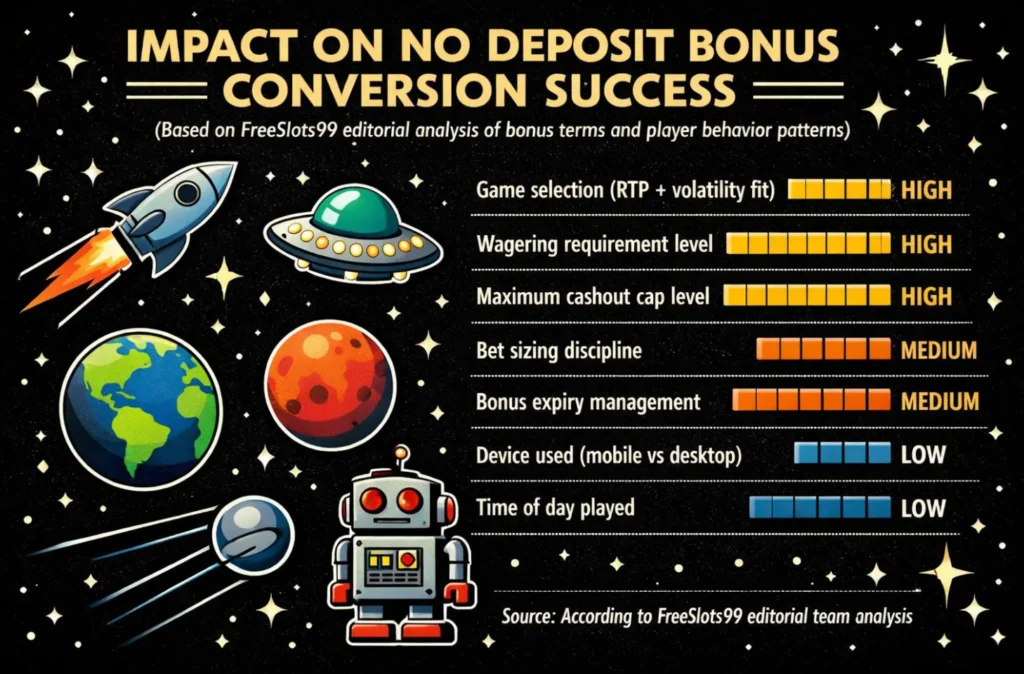
Higher RTP games reduce the long-run cost of generating wager volume. Over time, that makes them more efficient tools for bonus clearing than lower-RTP alternatives. A few percentage points of RTP can materially affect how much balance remains by the time the wagering target is reached.
That does not mean the highest theoretical RTP is always the best practical choice. Availability, volatility, and bonus eligibility still matter. A slot with strong RTP is useless if the operator excludes it from the promotion or if its variance drains the bonus too quickly.
Modern casino platforms are usually mobile-friendly, so the main difference between mobile and desktop is not fairness but session control. Desktop play can make it easier to read paytables, bonus rules, and wagering trackers. Mobile play can make it easier to split play into shorter, controlled sessions.
From a practical standpoint, whichever device helps you avoid rushed decisions and oversized bets is the better one for no deposit play.
Bonus funds should be treated with the same discipline as deposited funds. Small, consistent bet sizing is usually more effective than aggressive wagering because it extends the lifespan of the balance and reduces the risk of breaching the maximum permitted stake under the terms.
It also helps to divide the bonus into smaller mental session blocks. Stopping periodically to check how much wagering remains can prevent frustration-driven decisions and keep the strategy aligned with the actual target.
Some players do better in one focused session, while others make better decisions in shorter bursts. The right approach depends on the expiry window and your own ability to stay disciplined. If the offer expires quickly, delaying too long can be a mistake. If the timer is more generous, spreading play into shorter sessions can reduce impulsive decisions.
The best timing strategy is the one that fits the expiry rule while helping you avoid emotional or rushed betting.
Game providers shape the feel, RTP profile, and volatility structure of the titles found in a casino lobby. Established studios with broad distribution tend to dominate bonus-eligible slot libraries, while newer providers often push more complex mechanics and higher volatility.
NetEnt remains one of the most recognizable slot providers, with long-running titles such as Starburst and Gonzo’s Quest still widely referenced in bonus discussions. These games are often used as examples because they are simple to understand, proven in the market, and familiar to players comparing classic low- and mid-volatility options.
Starburst is especially notable for its low-volatility profile, while Gonzo’s Quest offers a more dynamic payout structure through avalanche-style mechanics. They suit different no deposit strategies, but both are generally easier for casual players to understand than many newer feature-heavy slots.
Microgaming, IGT, Playtech, and Evolution remain important names in online casino gaming, though they serve different niches. Microgaming and Playtech are associated with broad slot catalogs, IGT is known for legacy casino brands, and Evolution dominates live dealer content. For no deposit strategy, however, the main question is not the provider name alone, but whether the specific game is eligible and how it contributes toward the promotion.
Some well-known jackpot-branded games may look appealing, but that does not make them efficient for bonus clearing. Progressive-style content is often less practical for promotions because it may carry lower RTP, higher volatility, or explicit bonus restrictions.
Newer studios continue to produce visually stronger and more volatile slot experiences, often with more complex mechanics than classic legacy titles. These can be appealing for entertainment value, but they are not automatically the best choice for bonus conversion. Higher volatility can be exciting, yet it can also drain a small promotional balance quickly.
As always, the best approach is to check the exact game’s RTP, volatility profile, and bonus eligibility before treating it as a serious no deposit option.
The legal framework for online casino gaming in the United States is determined state by state. That creates a fragmented market in which a casino can be fully legal in one jurisdiction and unavailable in another. Players should never assume that a nationally recognized brand is automatically legal for them everywhere.
The regulated online casino landscape is still relatively limited compared with other forms of online betting. While some states are well established, others have narrower frameworks, fewer operators, or more limited product availability. The safest editorial approach is to treat current access as a moving target and verify the exact operator, product, and state approval before signing up.
In all cases, players must be physically located inside the relevant state at the time of play. Geolocation checks are standard, and access can be restricted automatically if the platform cannot confirm the player’s location.
If your state does not have active regulated online casinos, your legal options may include social casinos, sweepstakes-style platforms, tribal gaming, or land-based play, depending on local law. These are not interchangeable categories, and they should not be described as if they offer the same legal protections or product structure as state-regulated iGaming.
That distinction matters because many readers confuse “free casino play” with “regulated no deposit casino bonuses.” They are not the same thing. One may be entertainment-focused with virtual currency; the other follows a real-money path with bonus terms, compliance checks, and withdrawal conditions.
Legislation in this sector changes regularly, and multiple states continue to discuss or evaluate iGaming. Because political timelines shift quickly, the safest editorial approach is to avoid presenting speculative legalization as a certainty. A state may have active bills, industry pressure, or public debate without any guarantee of launch in the near term.
For readers, the practical rule is simple: rely on current operator availability and official state-level information, not projections alone.
FreeSlots99 uses a structured, multi-stage evaluation process before recommending any no deposit casino bonus to U.S. readers. The methodology prioritizes legal clarity and operator transparency first, followed by bonus value, game usability, and withdrawal practicality. Every listing should be judged as a real player-facing offer, not as a headline promotion taken at face value.
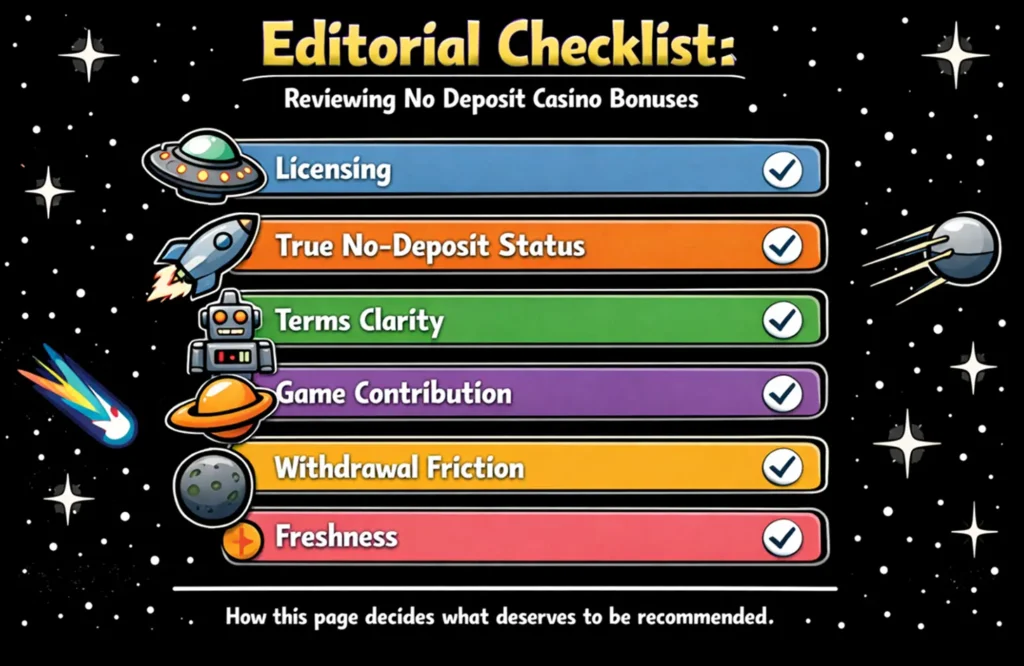
If an offer changes too often, hides critical terms, or cannot be matched to a transparent operator framework, it should be downgraded or excluded. That approach helps separate genuinely usable no deposit offers from marketing-heavy pages that look attractive but provide weak real value.
Understanding bonus terminology reduces confusion and lowers the chance of making an avoidable mistake. Below are 20 core terms readers should understand before using no deposit promotions.
No deposit bonuses should still be treated as real gambling activity when they involve real-money operators, age checks, identity verification, and the possibility of cash withdrawals. Set limits before you play, avoid chasing losses, and stop if the promotion pushes you into rushed decisions. If gambling stops feeling controlled, use your operator’s responsible gaming tools or step away before continuing.
Yes, but only when the offer is genuine, the platform follows a legal real-money model for your location, and the bonus terms are completed successfully. The real issue is not whether it can happen in theory, but whether the exact offer gives you a realistic path to cashable funds.
No slot pays real money simply because it is free to launch. A slot only becomes part of a real-money path if it is used under a valid no deposit offer or another qualifying legal model, and only if the operator allows those winnings to become cashable after the terms are met.
Most do. Truly no-wager offers exist, but they are uncommon and should be treated as exceptions rather than the default. Players should assume there are terms attached unless the casino clearly states otherwise.
Because the “no deposit” part describes the promotion, not the compliance process. Real-money operators still need to verify age, identity, and location before approving a payout, even if the bonus itself was claimed without depositing first.
In most cases, the bonus and any related promotional winnings expire when the deadline ends. That usually means the player loses the chance to convert the remaining balance into cashable funds.
Most no deposit bonuses are designed for new players only. Existing users are more likely to see reload bonuses, loyalty rewards, free spin drops, or other retention-focused promotions instead of true first-time no deposit offers.
No. Sweepstakes-style platforms use a different promotional structure and should not be treated as identical to state-regulated online casino bonuses. They may look similar in search results, but the legal model, currency system, and redemption rules are not the same.
The safest method is to confirm the operator through a regulator, official operator list, or another clearly documented approval framework, then check the bonus terms for wagering, cashout caps, excluded games, and verification rules before you register.
Free casino games that can lead to real-money withdrawals through no deposit offers are still part of the online casino market in 2026, but they are far less simple than the marketing language often suggests. The strongest opportunities come from transparent operators, realistic bonus structures, and games that actually help the player meet the terms efficiently.
The best practical route usually involves verifying the platform first, understanding whether you are dealing with a regulated no deposit bonus or another type of free-play model, choosing eligible high-efficiency games, and paying close attention to wagering, expiry, and maximum cashout rules. A smaller, cleaner offer is often worth more than a larger bonus with restrictive conditions.
The single most important factor is clarity. A transparent offer with visible terms, a realistic path to cashable funds, and a platform you can verify is far more valuable than a flashy headline attached to vague rules. For most readers, the best free online casino games win real money no deposit only when legality, usability, and disciplined play all align.
This guide was created for U.S. readers looking for legitimate ways to play free online casino games that may lead to real-money withdrawals through no deposit offers. It was reviewed for clarity, legal-context accuracy, and player-first usefulness.

Senior iGaming Writer
Filip Gromovic
Filip Gromovic is the lead author of this page. He focuses on online casino offers, slot reviews, and player education content, with a strong emphasis on practical bonus terms, game selection, and readable no-fluff explanations.
More info on Filip Gromovic


Senior iGaming Reviewer
Nashon Khamala
Nashon Khamala reviewed this article for consistency and factual accuracy. He checks bonus terminology, legal-state framing, consumer-protection context, and whether the page clearly separates regulated no deposit offers from sweepstakes and demo-only play.
More info on Nashon Khamala