
We have over 26,000 FREE games. Start here.
Updated: April, 2026
High volatility slots pay out less often than other slot types — but when they do hit, the wins can be life-changing. That is the core of what high volatility means in slots: elevated risk in exchange for the potential of a massive, concentrated reward. If you have ever wondered why some sessions feel like endless dead spins followed by one enormous payout, this is the mechanic behind it.
In practical terms, a single bonus round in a high variance game like Gates of Olympus 1000 or Money Train 4 can pay 6,000x, 10,000x or even 15,000x your bet. You might go hundreds of spins without a meaningful return, and then one feature round changes the session entirely. Compare that to low volatility slots, which deliver small wins frequently and keep your balance moving steadily.
In this guide we cover everything you need: what high volatility actually means mathematically, how it compares to low and medium variance, how to spot it in a paytable, the best high volatility slot machines available in 2026, bankroll strategy, and the most common myths players believe about these games.
High volatility in slots describes how a game distributes its payouts. A high volatility slot produces wins less frequently, but those wins tend to be significantly larger when they do occur. The result is an unpredictable session experience: long stretches with little or no return, interrupted by occasional large payouts or feature rounds that can change the session entirely.
Here are the key characteristics to understand:

Importantly, high volatility is about payout distribution, not fairness or odds. A high variance game is not more likely to pay you — it simply pays less often but in larger amounts when it does. The return-to-player (RTP) percentage can be identical to a low volatility game; only the shape of the returns changes. High volatility also does not mean better odds. The frequency at which bonuses and top payouts trigger is fixed inside the game’s mathematics and cannot be influenced by bet size, timing, or any external factor.
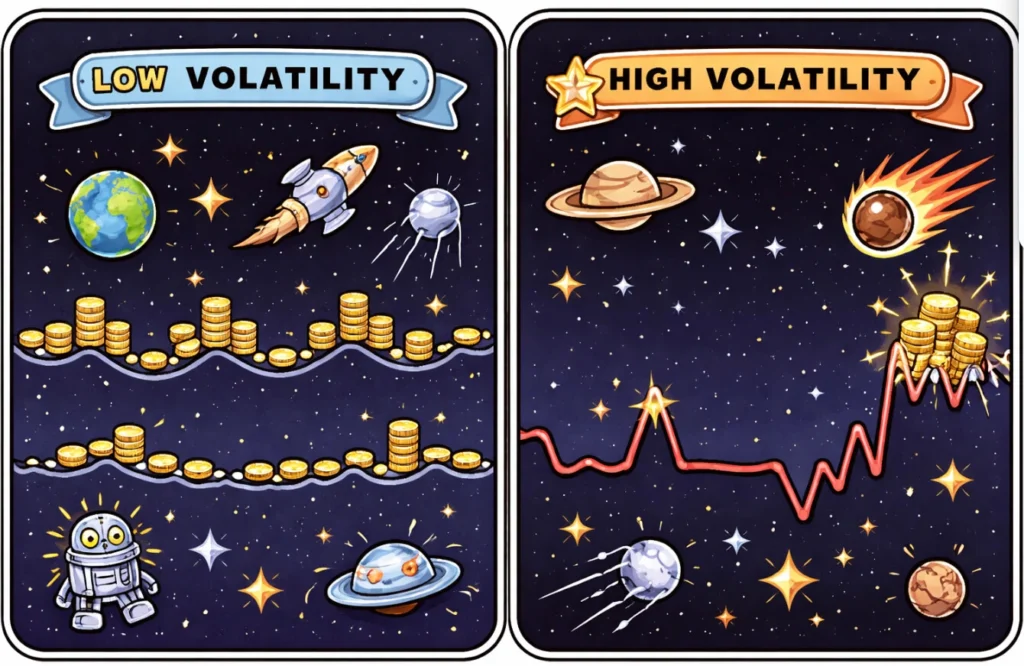
Understanding how high, medium, and low volatility compare helps you choose games that match your session goals. The differences are not about which type is “better” — they are about which payout structure suits your bankroll, available time, and risk appetite.
High volatility slots have a low hit rate — meaning a small proportion of spins result in a win. When wins do occur, they tend to be significantly larger than in other types. Balance swings are extreme: long downward runs are common, followed by a concentrated payout. A larger bankroll and patience are both required. Examples: Dead or Alive 2, Tombstone RIP, Gates of Olympus 1000.
Medium volatility slots offer a middle path. Hit frequency is moderate — you will see wins regularly enough to keep your balance moving, but occasional larger payouts are also possible. Session length and bankroll requirements fall between the two extremes. Examples: Book of Ra, Reactoonz, Big Bass Bonanza (base game). See our medium volatility slots guide for a full breakdown.
Low volatility slots pay out frequently but in small amounts. Hit rates are high — you will see a win on a large proportion of spins, but those wins rarely exceed 10–50x your bet. Balance swings are minimal. These games are well suited to smaller bankrolls, shorter sessions, and players who prefer steady engagement over high-risk play. See our low volatility slots guide for recommendations.
One important point: RTP can be similar across all three types. Volatility only changes how returns are distributed over time — not the total theoretical return percentage. Choosing by volatility is a decision about your playing experience, not a mathematical advantage.
| Feature | Low Volatility | Medium Volatility | High Volatility |
| Hit rate | High (frequent wins) | Moderate | Low (rare wins) |
| Win size | Small (10–200x) | Moderate | Large (1,000x–300,000x) |
| Balance swings | Small, steady | Moderate | Large, unpredictable |
| Bankroll needed | Low | Moderate | High (100–200× bet) |
| Session length | Any | Any | Longer sessions recommended |
| Patience required | Low | Moderate | High |
| RTP | Can be high or low | Can be high or low | Can be high or low |
RTP (Return to Player) and volatility are two separate measurements that describe different things about a slot. Players often confuse them, which leads to poor game selection and unrealistic session expectations. Understanding how they interact is one of the most useful things you can learn before playing high variance games.
RTP is a long-run percentage. A slot with 96% RTP will return, on average, £96 for every £100 wagered — but only across millions of spins. In any individual session, your result could be far above or below that figure. The RTP calculator on this site can help you see what this means for specific stake sizes.
Volatility describes how that RTP is delivered. Two slots can share the same 96% RTP but feel completely different to play. A low volatility slot distributes that 96% across hundreds of small, frequent wins during a session. A high volatility slot concentrates most of that same 96% into a handful of large events — bonus rounds, max-win scenarios — while returning almost nothing during the stretches between them.
This matters practically in several ways:
The practical takeaway: when choosing a high volatility slot, check both RTP and volatility separately. A game with 96%+ RTP and high volatility gives you the best theoretical long-run return in the high variance category — but still requires a large enough bankroll and session length to reach the feature rounds where most of that RTP is delivered. For a deeper look at what RTP actually means, see our guide: what does RTP mean in slots.
Not all slots clearly label their volatility level. Some display a 1–5 risk rating or a lightning bolt icon on the loading screen; many do not. Learning to read the signals yourself — especially from the paytable — is a practical skill that applies to any game you encounter. Here is how to read a slot paytable if you need a primer first.
A note on progressive jackpots: they do not automatically make a slot high volatility. The jackpot contribution layer may be high variance, while the base game itself is medium or even low variance. Evaluate the base game and bonus mechanics separately from the jackpot tier.
Before committing real money to a high variance game, run through these checks. They take under two minutes and significantly reduce the chance of an unpleasant surprise mid-session.
The games below represent the strongest high volatility titles currently available at online casinos. Selection is based on maximum win potential, RTP, the quality of the variance mechanic, and player and industry recognition. Every game in this list can be tried in demo mode before playing for real money.
| Title | Max Win | Provider | RTP | Key Variance Mechanic |
| Razor Returns | 100,000x | Push Gaming | 96.55% | Razor reveals and mystery stacks |
| Gates of Olympus 1000 | 15,000x | Pragmatic Play | 96.50% | Multipliers up to 1,000x in free spins |
| Fire in the Hole 2 | 65,000x | Nolimit City | 96.07% | xBomb multiplier and cascading reels |
| Peking Luck | 180,000x | Pragmatic Play | 96.50% | 18x wide multipliers in free spins |
| Dead or Alive 2 | 111,111x | NetEnt | 96.82% | Sticky wide multipliers — High Noon Saloon mode |
| San Quentin xWays | 150,000x | Nolimit City | 96.03% | Enhancer cells and jumping wilds |
| Money Train 4 | 150,000x | Relax Gaming | 96.10% | Persistent Collector/Payer mechanics |
| Tombstone RIP | 300,000x | Nolimit City | 96.08% | Extreme xNudge wilds — highest max win in this list |
| Sugar Rush 1000 | 25,000x | Pragmatic Play | 96.53% | Multiplier spots doubling up to 1,024x |
| Zeus vs. Hades | 15,000x | Pragmatic Play | 96.07% | Toggle Hades mode for extra variance |
| Book of Dead | 5,000x | Play’n GO | 96.21% | Expanding special symbol in free spins |
| Mental | 66,666x | Nolimit City | 96.08% | Split symbols and fire frames |
| Hand of Anubis | 10,000x | Hacksaw Gaming | 96.24% | Soul Orbs and Underworld progression |
| Chaos Crew 2 | 20,000x | Hacksaw Gaming | 96.27% | Cranky Cat and Sketchy Skull multipliers |
| Starburst XXXtreme | 200,000x | NetEnt | 96.26% | High-stakes wilds with up to 450x boost |
| Wanted Dead or a Wild | 12,500x | Hacksaw Gaming | 96.03% | Versus symbols with multipliers up to 100x |
| Book of 99 | 5,000x | Relax Gaming | 99.00% | Wild collection meter — best RTP in this list |
| Mega Joker | 2,000x | NetEnt | 99.00% | Supermeter and mystery prize — classic high-RTP variance |
| Jackpot 6000 | 6,000x | NetEnt | 98.90% | Supermeter, small grid, big risk mode |
| 9k Yeti | 9,000x | 4ThePlayer | 97.00% | Snowstorm feature and portrait big reel |
In the games above, the vast majority of theoretical return is locked inside feature rounds, not the base game. Understanding this structure is essential for managing expectations during a session.
During normal base game spins, payouts will be small or absent. These periods — sometimes called “dead spins” — are when no meaningful payout appears for many consecutive rounds. This is not a malfunction; it is the designed behaviour of a high variance game. Your balance will gradually decrease until a scatter combination, bonus trigger, or special symbol sequence activates a feature round. The base game serves primarily to build anticipation, not to return value.
Once the feature activates, the payout dynamics shift significantly. Free spins with accumulating multipliers, stacked wilds, expanding reels, or progressive collector mechanics can multiply a single win by an order of magnitude compared to base game results. This concentrated structure — most of the game’s theoretical return packed into fewer, more powerful events — is exactly what defines high volatility gameplay. To understand how free spins work in these games, our dedicated guide covers the mechanics in detail.
Multipliers are the primary engine behind extreme win sizes in high variance slots. Here is why multiplier mechanics amplify volatility so effectively:
Most players assume high volatility means lower RTP — but this is not the case. Several of the strongest high variance games combine extreme win potential with the highest available RTPs. Book of 99 (99% RTP), Mega Joker (99% RTP), and Jackpot 6000 (98.9% RTP) are all high volatility titles. These games give you the best theoretical long-run return in the high variance category. See our highest RTP slots guide and the 99% RTP slots list for more options in this category.
The right volatility level is not a fixed answer — it depends on what you want from a session. Here is how to match volatility to your situation:
If you are unsure which category suits you, the free slot volatility calculator on this site helps you compare risk levels across specific games. You can also use our volatility explainer for a broader overview of how the concept applies to different game types.
High variance games require a different approach to bankroll management than any other slot type. The standard advice about setting a loss limit applies here — but the specifics need to account for the long dry spells that are a normal feature of these games. The planner below will calculate a session structure based on your inputs.
Calculate your spin buffer, stop-loss, and win goal before you start.
Recommended spin buffer (100–200× rule)
—
—
Stop-loss suggestion (your %)
—
—
Win-goal suggestion (2× / 3× / 5×)
—
—
High variance slots attract more myths and misconceptions than almost any other casino game type — partly because the long losing streaks feel unnatural, and partly because large wins feel like they must have a cause beyond random chance. Here are the most common beliefs that are simply not true:
A high-volatility slot is built around larger win potential with less frequent payouts. That means longer dry spells between wins, followed by occasional larger hits, bonus round payouts, or max-win outcomes. The game's theoretical return is concentrated in rare events rather than distributed across regular small wins.
No practical difference. In slot terminology, "volatility" and "variance" are used interchangeably to describe how unpredictable and concentrated a game's payout distribution is. Some providers prefer one term over the other, but they refer to the same mathematical characteristic.
Neither is inherently better — it depends on your goals. High volatility suits players chasing a single large win who have the bankroll and patience for long dry spells. Low volatility suits players who prefer consistent engagement and smaller, regular wins. RTP can be identical between the two types.
Multipliers do not change the probability of landing a winning spin. They only increase the size of a payout when one occurs — a 5x multiplier turns a $10 base win into $50. The multiplier itself has no effect on whether the winning combination appears in the first place.
A global multiplier applies to all wins during a feature round and typically grows as the round progresses. Because it stacks and amplifies later wins far more than earlier ones, it creates highly unpredictable outcomes — the same free spin session could end at 50x or 5,000x depending on where the multiplier reaches by the time the biggest winning spin occurs. Examples include Sugar Rush and Gates of Olympus.
Bonus buy guarantees entry to the feature round and typically carries a similar or slightly lower RTP to organic play — it does not improve your odds. The outcome within the feature is still RNG-determined. The main practical effect is that you are concentrating the same variance into fewer, more expensive spins rather than spreading it across many base-game spins.
No. Each spin result is generated independently by the RNG. The game has no memory of previous outcomes and does not enter a "cold" state after a large payout. The mathematical probability of any given outcome is identical on every spin regardless of what came before.
It is not always lower. RTP is determined by the individual game's mathematical model, independently of its volatility level. You will find high volatility slots with 99% RTP (Book of 99, Mega Joker) and others with 94–95% RTP. Volatility describes how the RTP is distributed, not how much it is.
"Pokies" is the Australian and New Zealand term for slot machines. High volatility pokies are identical in concept to high volatility slots — they pay infrequently but can produce large wins when the feature rounds trigger. The same games described in this guide (Dead or Alive 2, Gates of Olympus, Tombstone RIP) are available as pokies through licensed online casinos in Australia and New Zealand.
No. RNG outcomes are independent of time of day, day of the week, or casino traffic volume. The only time-related factor that matters is session length — high variance games benefit from longer sessions because features take time to trigger. A 10-minute session in a high variance game may end before reaching any significant payout event.
High volatility slots are designed for entertainment. The long losing streaks and high-pressure bonus rounds that define these games can be engaging — but they can also be distressing if your expectations or spending are not managed carefully. If you find yourself chasing losses, spending more than you planned, or feeling that gambling is affecting your mood or finances, please use the resources below.
All reputable online casinos offer deposit limits, session time limits, self-exclusion tools, and reality check reminders. Use them before you start playing, not after a difficult session.
The casinos below have been reviewed for their game library quality, licensing, and bonus structure. For high volatility play, look for casinos that offer a wide selection of titles from Nolimit City, Hacksaw Gaming, Relax Gaming, and Pragmatic Play — the providers with the strongest high variance catalogues. Wagering requirements on bonuses also matter more for high volatility play, since reaching the bonus round may require more spins than with low variance games.

 100/100
 RTP: 98%
 Payout: 1–3 days
 Games: 500+
 100/100
RTP: 99%
Payout: 0–1 days
Games: 2000+
100/100
RTP: 99%
Payout: 0–1 days
Games: 2000+
 100/100
 100/100
 100/100
 100/100
 100/100
 100/100
 97/100
RTP: 97%
Payout: 1–3 days
Games: 3000+
97/100
RTP: 97%
Payout: 1–3 days
Games: 3000+
 100/100
RTP: 96%
Payout: 1–3 days
Games: 200+
100/100
RTP: 96%
Payout: 1–3 days
Games: 200+
 100/100
RTP: 96%
Payout: 1–3 days
Games: 200+
100/100
RTP: 96%
Payout: 1–3 days
Games: 200+
 100/100
 100/100
RTP: 96%
Payout: 1–3 days
Games: 200+
100/100
RTP: 96%
Payout: 1–3 days
Games: 200+
 100/100
RTP: 96%
Payout: 1–3 days
Games: 200+
100/100
RTP: 96%
Payout: 1–3 days
Games: 200+
 100/100
RTP: 96%
Payout: 1–3 days
Games: 200+
100/100
RTP: 96%
Payout: 1–3 days
Games: 200+
 100/100
RTP: 96%
Payout: 1–3 days
Games: 200+
100/100
RTP: 96%
Payout: 1–3 days
Games: 200+
 100/100
RTP: 96%
Payout: 1–3 days
Games: 200+
100/100
RTP: 96%
Payout: 1–3 days
Games: 200+
 100/100
RTP: 96%
Payout: 1–3 days
Games: 200+
100/100
RTP: 96%
Payout: 1–3 days
Games: 200+
 100/100
RTP: 96%
Payout: 1–3 days
Games: 200+
100/100
RTP: 96%
Payout: 1–3 days
Games: 200+
 97/100
RTP: 96%
Payout: 1–3 days
Games: 200+
97/100
RTP: 96%
Payout: 1–3 days
Games: 200+
 100/100
RTP: 96%
Payout: 1–3 days
Games: 200+
100/100
RTP: 96%
Payout: 1–3 days
Games: 200+
 100/100
RTP: 96%
Payout: 1–3 days
Games: 200+
100/100
RTP: 96%
Payout: 1–3 days
Games: 200+
 100/100
RTP: 96%
Payout: 1–3 days
Games: 200+
100/100
RTP: 96%
Payout: 1–3 days
Games: 200+
 100/100
RTP: 96%
Payout: 1–3 days
Games: 200+
100/100
RTP: 96%
Payout: 1–3 days
Games: 200+
 100/100
RTP: 96%
Payout: 1–3 days
Games: 200+
100/100
RTP: 96%
Payout: 1–3 days
Games: 200+
 100/100
 100/100
RTP: 96%
Payout: 1–3 days
Games: 200+
100/100
RTP: 96%
Payout: 1–3 days
Games: 200+
 100/100
RTP: 96%
Payout: 1–3 days
Games: 200+
100/100
RTP: 96%
Payout: 1–3 days
Games: 200+
 100/100
RTP: 96%
Payout: 1–3 days
Games: 200+
100/100
RTP: 96%
Payout: 1–3 days
Games: 200+
 100/100
RTP: 96%
Payout: 1–3 days
Games: 200+
100/100
RTP: 96%
Payout: 1–3 days
Games: 200+
 100/100
RTP: 97%
Payout: 1–3 days
Games: 3000+
100/100
RTP: 97%
Payout: 1–3 days
Games: 3000+
 96/100
RTP: 99%
Payout: 0–1 days
Games: 2000+
96/100
RTP: 99%
Payout: 0–1 days
Games: 2000+
 100/100
RTP: 97%
Payout: 0–3 days
Games: 500+
100/100
RTP: 99%
Payout: 0–1 days
Games: 2000+
100/100
RTP: 97%
Payout: 0–3 days
Games: 500+
100/100
RTP: 99%
Payout: 0–1 days
Games: 2000+
 100/100
RTP: 97%
Payout: 0–3 days
Games: 400+
100/100
RTP: 97%
Payout: 0–3 days
Games: 400+
 100/100
RTP: 96%
Payout: 1–3 days
Games: 200+
100/100
RTP: 96%
Payout: 1–3 days
Games: 200+
 100/100
RTP: 96%
Payout: 1–3 days
Games: 200+
100/100
RTP: 96%
Payout: 1–3 days
Games: 200+
 NEW
NEW
 96/100
RTP: 96%
Payout: 1–3 days
Games: 200+
96/100
RTP: 96%
Payout: 1–3 days
Games: 200+
 100/100
RTP: 97%
Payout: 0–3 days
Games: 400+
100/100
RTP: 97%
Payout: 0–3 days
Games: 400+
 100/100
RTP: 97%
Payout: 0–3 days
Games: 400+
100/100
RTP: 97%
Payout: 0–3 days
Games: 400+
 100/100
RTP: 96%
Payout: 1–3 days
Games: 200+
100/100
100/100
RTP: 96%
Payout: 1–3 days
Games: 200+
 100/100
RTP: 96%
Payout: 1–3 days
Games: 200+
100/100
RTP: 96%
Payout: 1–3 days
Games: 200+
 100/100
RTP: 96%
Payout: 1–3 days
Games: 200+
100/100
RTP: 96%
Payout: 1–3 days
Games: 200+
 100/100
RTP: 96%
Payout: 1–3 days
Games: 200+
100/100
RTP: 96%
Payout: 1–3 days
Games: 200+
 100/100
 100/100
RTP: 97%
Payout: 1–3 days
Games: 3000+
100/100
RTP: 97%
Payout: 1–3 days
Games: 3000+
 100/100
RTP: 96%
Payout: 1–3 days
Games: 200+
100/100
RTP: 96%
Payout: 1–3 days
Games: 200+
 100/100
RTP: 97%
Payout: 0–3 days
Games: 400+
100/100
RTP: 97%
Payout: 0–3 days
Games: 400+
 100/100
RTP: 97%
Payout: 0–3 days
Games: 400+
100/100
RTP: 97%
Payout: 0–3 days
Games: 400+
 100/100
RTP: 97%
Payout: 0–3 days
Games: 400+
100/100
RTP: 97%
Payout: 0–3 days
Games: 400+
 100/100
RTP: 97%
Payout: 0–3 days
Games: 400+
100/100
RTP: 97%
Payout: 0–3 days
Games: 400+
 100/100
RTP: 97%
Payout: 0–3 days
Games: 400+
100/100
RTP: 97%
Payout: 0–3 days
Games: 400+
 100/100
RTP: 96%
Payout: 1–3 days
Games: 200+
100/100
RTP: 96%
Payout: 1–3 days
Games: 200+
 100/100
RTP: 96%
Payout: 1–3 days
Games: 200+
100/100
RTP: 96%
Payout: 1–3 days
Games: 200+
 96/100
RTP: 98%
Payout: 1–3 days
Games: 500+
96/100
RTP: 98%
Payout: 1–3 days
Games: 500+
 100/100
RTP: 99%
Payout: 0–1 days
Games: 2000+
100/100
RTP: 99%
Payout: 0–1 days
Games: 2000+
 100/100
 EXCLUSIVE BONUS
 TOP
TOP
 98/100
RTP: 99%
Payout: 0–1 days
Games: 2000+
98/100
RTP: 99%
Payout: 0–1 days
Games: 2000+
 100/100
RTP: 98%
Payout: 1–3 days
Games: 500+
NEW
100/100
RTP: 98%
Payout: 1–3 days
Games: 500+
NEW
 96/100
RTP: 96%
Payout: 1–3 days
Games: 200+
96/100
RTP: 96%
Payout: 1–3 days
Games: 200+
 100/100
RTP: 96%
Payout: 1–3 days
Games: 200+
100/100
RTP: 96%
Payout: 1–3 days
Games: 200+
 HOT
HOT
 97/100
RTP: 96%
Payout: 1–3 days
Games: 200+
97/100
RTP: 96%
Payout: 1–3 days
Games: 200+
 100/100
RTP: 96%
Payout: 1–3 days
Games: 200+
100/100
RTP: 96%
Payout: 1–3 days
Games: 200+
 97/100
RTP: 96%
Payout: 1–3 days
Games: 200+
97/100
RTP: 96%
Payout: 1–3 days
Games: 200+
 100/100
RTP: 99%
Payout: 0–1 days
Games: 3000+
100/100
RTP: 99%
Payout: 0–1 days
Games: 3000+
 100/100
RTP: 96%
Payout: 1–3 days
Games: 200+
100/100
RTP: 96%
Payout: 1–3 days
Games: 200+
 97/100
RTP: 98%
Payout: 1–3 days
Games: 500+
97/100
RTP: 98%
Payout: 1–3 days
Games: 500+
 100/100
RTP: 99%
Payout: 0–1 days
Games: 2000+
100/100
RTP: 99%
Payout: 0–1 days
Games: 2000+
 100/100
RTP: 99%
Payout: 0–1 days
Games: 2000+
100/100
RTP: 99%
Payout: 0–1 days
Games: 2000+


Reel in 3000$ Welcome Bonus


