


Chicken Road Casino
Written by: Filip Gromovic · Reviewed by: Nashon Khamala
Read time: 14 minutes · Last verified: April 2026
Chicken Road is a step-multiplier title by InOut Games with a certified 98% RTP — higher than most online slots (94–96%) and the average crash format (96–97%). You control a chicken crossing a path of hidden traps; each safe step raises the multiplier, and you decide exactly when to cash out. The maximum win is $20,000 per round. A free practice session with no registration is available. Everything below covers how the game works, what the difficulty modes actually change, where to play with real stakes, and what a realistic bankroll approach looks like.
What Is Chicken Road and How Does It Work
Chicken Road is a crash-format title released by InOut Games in April 2024. It does not use reels, paylines, or symbol combinations — the entire mechanic is a chicken moving step by step through a grid that conceals hidden traps. After each safe step, the payout multiplier climbs. You choose when to cash out. If the chicken hits a trap before you exit, your bet is lost.
That structure places it in a specific sub-genre: the step-multiplier format. It is categorically different from curve-based titles like Aviator, where a multiplier rises automatically until a random crash point and your only lever is timing your exit. In Chicken Road, you are actively advancing the chicken — each step is a deliberate decision, not a passive wait.
How Chicken Road Differs from Traditional Slots
Three mechanical differences are worth understanding before you play. First, there are no predetermined paylines — every round’s outcome depends entirely on where the traps are placed and when you stop. Second, RTP is a function of the multiplier structure and trap probability at each step; in a slot, it is baked into the symbol frequency table and you have no input. Third, volatility is directly player-selectable via difficulty mode, whereas in slots it is a fixed property of the game you cannot change mid-session. In a slot, volatility is fixed — you cannot change it. In Chicken Road, you select your volatility before every single round via the difficulty mode selector.
How to Play Chicken Road — Step by Step
Placing Your Bet
Set your stake before the round begins — most operators accept between $0.50 and $200 per round, though exact limits vary. Your stake is fixed for the entire round; you cannot adjust it mid-path. Choose a bet size relative to your session budget, not relative to how lucky you are feeling. Select your difficulty mode — Easy, Medium, Hard, or Hardcore. Pre-set your cash-out multiplier target before pressing Play. Once you press Play the stake is locked. After that, advance or cash out at each step — there is no time pressure.
Choosing Your Difficulty Mode
This is the single most important decision in this game. Your choice of mode determines how many traps are hidden in the path, which controls both how often you survive each step and how high the multiplier ceiling goes. The RTP does not change between modes — the house edge is 2% across all four. What changes is how fast and how violently your session swings.
❝
“The ability to select volatility before each round is a genuinely novel player control mechanism. Traditional RNG games present volatility as a fixed game property; giving players a live selector fundamentally changes the session management dynamic.”
Dr. Mark Griffiths, Professor of Behavioural Addiction, Nottingham Trent University — ntu.ac.uk
The Multiplier System — How Payouts Grow
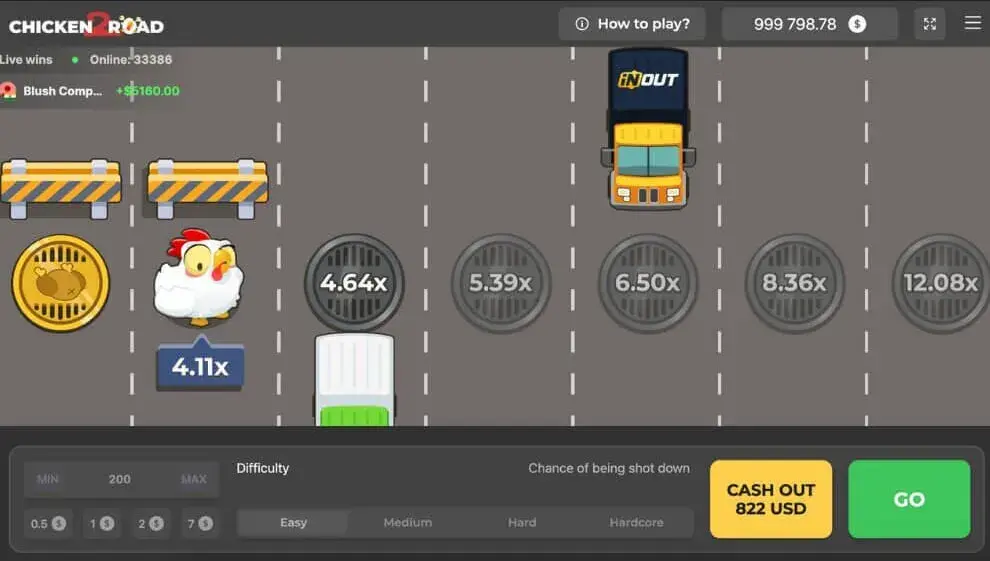
After pressing Play, the chicken moves forward through a 25-cell grid. Each cell is either safe or a trap — you do not know which until the chicken reaches it. Every safe cell crossed increases the multiplier. The multiplier increments are steeper on higher difficulty modes because the traps are more densely placed, so surviving each step is statistically harder and the reward structure compensates accordingly.
When and How to Cash Out
After each safe step, a cash-out button appears alongside the current multiplier. Press it and you collect your bet multiplied by that figure. Do nothing and the chicken advances to the next cell automatically. There is no time pressure. The single most useful habit here is deciding your target cash-out multiplier before the round starts and committing to it regardless of how the early steps feel. Players who set targets mid-round consistently hold one step too many. The near-miss effect is structural — pre-commitment is the only defence against it.
Chicken Road RTP and Variance — What the Numbers Actually Mean
The RTP is 98%, independently certified by iTech Labs in March 2026. That means for every $100 wagered across a very large number of rounds, the game returns $98 on average. The $2 difference is the house edge — the mathematical cost of playing, and it cannot be removed by any strategy. Short-run variance dominates in this format. The 98% figure is a statistical average over millions of rounds; in any single session of 50 or 100 rounds, your actual return can be far above or below it.
Most online slots sit at 94–96% RTP; blackjack with basic strategy reaches approximately 99.5%; Aviator is certified at 97%; Chicken Road sits at 98%. Among games you can play right now in a browser without a download, 98% places it in the top tier. It is not the highest RTP game available — BGaming Plinko is certified at 99% — but it is well above the category average for both slots and step-multiplier formats. The house edge is 2%. Applied to actual funds: on $500 of total action in a session, the expected mathematical loss is $10. On $2,000 of action, $40. These are expected values, not guarantees — individual sessions deviate substantially.
The Four Difficulty Modes Explained
The difficulty mode is not a cosmetic setting. It is the primary variable controlling your session experience — how often you survive, how high the multipliers go, and how quickly your budget depletes on a bad run. The RTP does not change between difficulty modes. The house edge is 2% on Easy, Medium, Hard, and Hardcore. What changes is how fast and how violently your session swings — not the long-run mathematical cost of playing.
Easy Mode — Low Pressure, Steady Pace
One trap in 25 cells means a ~4% chance of elimination on any given step. The probability of completing the full 25-step path without elimination is approximately 36% per round. Most rounds will progress well into the path before you choose to exit, which makes Easy mode genuinely useful for developing your cash-out instinct. The multiplier ceiling of approximately 24.5× is modest — you are not going to collect a life-changing payout on Easy. What you will do is build a rhythm, learn how the game paces itself, and establish a consistent cash-out habit without burning through your session budget.
Medium Mode — Balanced Risk and Reward
Three traps across 25 cells produces a ~12% per-step trap probability — low enough to progress meaningfully across many rounds, high enough that you will feel the tension build as you go deeper. The multiplier ceiling clears 100× on deeper runs, giving you genuine upside without requiring the near-perfect survival sequences Hard and Hardcore demand. Medium is the most practical mode for sustained regular play and the default choice for most experienced players.
Hard Mode — High Volatility, Steep Multiplier Curve
Five traps in 25 cells means you will be eliminated on roughly one in five steps — frequent early exits are a routine part of the session rather than an occasional bad beat. Going deep on Hard requires sustained luck. The payoff is a multiplier curve that climbs far faster than Easy or Medium can reach in equivalent steps. Hard mode is suited to players who have already logged significant time on Medium and are comfortable with frequent individual losses.
Hardcore Mode — Maximum Variance Environment
Ten traps in 25 cells means a 40% trap probability per step. The majority of Hardcore rounds end in the first few steps. The theoretical multiplier ceiling reaches into the millions, but the $20,000 operator win cap applies regardless. Hardcore is for players who explicitly want to accept a high frequency of losses in exchange for the rare shot at a very large multiplier. A session budget of $100 on Hardcore means a maximum bet of $0.25 per round. At 40% trap probability per step, consecutive losses are the expected baseline, not the exception.
Free Demo — How to Try Chicken Road Without Risking Money
Every difficulty mode is available in a free practice session that requires no registration and no deposit. It runs identical game logic to the live version — same RNG, same multiplier structure, same trap probabilities. The only difference is that credits are virtual and winnings cannot be withdrawn. Run at least 50 rounds on your chosen difficulty in the free version before switching to live stakes.
The free version is genuinely useful and not just a marketing formality. The cash-out decision is the central skill here, and it requires repetition to develop a consistent approach. What the demo cannot replicate is the emotional pressure of live play — the near-miss effect operates differently when the stakes are virtual. Use it to develop your mechanics and cash-out habits; be aware that sessions with actual funds will test those habits in a way practice play does not.
Chicken Road Strategy — Practical Habits That Reduce Losses
There is no strategy that removes the 2% house edge. What strategy does is prevent you from making it worse through behavioural errors that compound the mathematical cost of play.
Set a Cash-Out Target Before Each Round
Decide on a target multiplier before pressing Play. Commit to cashing out the moment you reach it, regardless of how the round feels at that point. Players who do not pre-commit reliably hold too long. The near-miss effect creates a false sense of momentum that is not a real signal. Pre-commitment is the structural defence against it.
Flat Betting vs. Progressive Staking
Flat betting — the same stake every round — is the correct approach here. Progressive systems like Martingale are particularly dangerous in this format because losing streaks are statistically normal, especially on Hard and Hardcore. A Martingale sequence on Hardcore can require bets of 32× or 64× the original stake after just five or six consecutive losses — and five consecutive first-step eliminations on Hardcore is well within normal variance given the 40% per-step trap probability.
Bet Sizing by Difficulty Mode
Bet sizing should be expressed as a percentage of your session budget. On Easy, a maximum of 2% of session budget per round is appropriate given the low trap frequency. On Medium, stick to 1.5%. On Hard, no more than 1% — a cold streak of six to eight consecutive early exits is entirely normal. On Hardcore, 0.25% is the ceiling, not a conservative suggestion. A session budget of $100 on Hardcore means a maximum bet of $0.25 per round. If that feels too small, play Medium or Hard — not increase the Hardcore bet size.
Why Streaks Signal Nothing
This title uses a provably fair RNG where each round’s outcome is determined independently of every previous round. A run of five consecutive losses on Medium does not make the next round more likely to be safe. A run of five deep runs does not mean the game is running hot. Each round begins from scratch. Treating streaks as signals — either to bet more after losses or to press further after wins — is the gambler’s fallacy in its most operationally dangerous form in this format.
Chicken Road 2 — What Changed and Is It Worth Switching
Chicken Road 2 is the sequel released by InOut Games following the original’s popularity. The sequel introduces an elevated visual environment and increased mechanical pressure — it is designed to feel more intense at each step, with updated visual and audio feedback that amplifies the near-miss effect. The core step-multiplier structure carries over: hidden traps, a climbing multiplier, and a player-controlled cash-out. The difficulty mode framework is retained.
For new players: start with the original. The cleaner interface makes the mechanics easier to read during your first sessions. For experienced players who have logged meaningful time on the original and are finding sessions feeling routine: the sequel’s heightened presentation adds novelty without requiring you to re-learn the underlying game. The certified RTP for the original is 98% — verify the sequel’s certification separately before wagering actual funds.
Where to Play Chicken Road for Real Money
Chicken Road is distributed through licensed operators carrying the InOut Games library. When evaluating where to play, three factors matter most: whether the operator holds a valid gaming licence, whether their bonus terms are compatible with this format, and whether their withdrawal process is straightforward for your jurisdiction.
Most welcome bonuses are structured around slots, which creates a compatibility issue worth understanding before you claim anything. Check whether Chicken Road contributes to wagering requirements — many operators set step-multiplier titles at 10–20% contribution versus 100% for slots. A bonus with a 30× wagering requirement and 10% contribution is effectively a 300× wagering requirement for a Chicken Road player. Either verify that this format contributes fully, or treat the bonus as a slots bonus and switch to this title after the requirement is cleared. Players looking to get started with a minimal commitment may want to explore $2 deposit casinos or $20 deposit casinos as a low-risk entry point.
Registration at any reputable operator follows the same sequence: create an account with a valid email address, complete identity verification (KYC) with a government-issued ID and proof of address, select a payment method, and make your first deposit. KYC is not optional at licensed operators and is typically required before your first withdrawal — completing it before you need to withdraw saves time. Withdrawal timelines depend on the operator and your chosen payment method — e-wallets typically process within 24 hours; bank transfers can take three to five business days. For players using BC.Game, the deposit guide and withdrawal walkthrough cover the full process including crypto conversion options.
Is Chicken Road Legit — Licensing, Fairness and Safety
Yes — it is a legitimate, independently certified title. The legitimacy question appears frequently because the game’s rapid spread through affiliate channels has generated understandable scepticism. The RNG was audited by iTech Labs and certified in March 2026, confirming that it produces statistically random outcomes consistent with the published 98% RTP. Before each round, a SHA-256 hash is generated combining a server seed and a client seed from your browser. After the round, you can independently verify that the outcome was predetermined before play began and was not altered during the round — making manipulation cryptographically impossible, not just a policy promise. InOut Games is distributed exclusively through licensed operators — clone games exist on unlicensed sites using the Chicken Road name and aesthetic, and these cannot be assumed to share the published RTP.
❝
“Provably fair cryptographic systems represent the gold standard for player trust in step-multiplier formats. The SHA-256 hash mechanism makes pre-round outcome verification independently accessible to any player without requiring trust in the operator.”
Steve Hoare, Editor-in-Chief, iGaming Business — igamingbusiness.com
How to Verify a Casino Is Licensed
Check the operator’s footer for a licensing authority name and licence number. Major recognised licences include the UK Gambling Commission (UKGC), Malta Gaming Authority (MGA), Gibraltar Regulatory Authority, and Curaçao eGaming. A licence number without a functioning verification link on the regulator’s public database is not adequate confirmation. If the site does not display a verifiable licence, do not deposit. Licensed operators are also required to offer deposit limits, session time limits, loss limits, self-exclusion, and reality checks — use the deposit limit before your first session.
Mobile Play — App vs. Browser
Chicken Road is built on HTML5 and runs natively in mobile browsers on both iOS and Android — no download required. Desktop, tablet, and mobile view modes are selectable from the in-game menu, with a maximum resolution of 1920×1080. Performance is consistent across modern devices. An official InOut Games APK is available for Android players who prefer a standalone install — download only from the official InOut Games source rather than third-party APK repositories. There is no gameplay difference between browser and app.
Chicken Road vs Other Crash Games — Full Comparison
With a 98% RTP, Chicken Road sits at the higher end of the crash game category. The key distinction between this title and Aviator — the most-played option globally — is the nature of player control. In Aviator, the multiplier climbs on its own and crashes at a randomly determined point. Your only decision is when to exit against an unknown crash point. In Chicken Road, you control the pace and actively advance the chicken — each step is a deliberate decision, not a reactive one. Players who find curve-based formats too passive frequently prefer this game for that reason.
What Real Players Say About Chicken Road
Reddit’s r/gambling threads on this title are consistently useful data on real player experience. Two recurring themes emerge: the near-miss compulsion at higher difficulty modes is the most commonly reported driver of faster-than-expected bankroll depletion — specifically, the tendency to take one more step after a long safe run. Players who report positive experiences consistently mention having a pre-set cash-out target that they stuck to; players who report frustrating sessions more often describe holding too long chasing a higher multiplier.
Players transitioning from slots often underestimate how quickly Hardcore mode depletes a session budget. The 40% per-step elimination rate feels abstract until you experience five consecutive first-step losses with actual funds on the line. Practice first, with appropriately sized bets on Hardcore if you decide to play it at all, is the consistent recommendation from experienced players across community discussions.
Frequently Asked Questions
Is Chicken Road a legitimate casino game or a scam?
Yes, it is legitimate. It is a certified step-multiplier title by InOut Games with an independently audited 98% RTP (iTech Labs, March 2026) and a provably fair RNG system. Clone sites using the Chicken Road name on unlicensed platforms are a separate concern — always confirm you are playing the InOut Games version at a licensed operator.
What is the RTP of Chicken Road?
98%, certified by iTech Labs in March 2026. The house edge is 2%. This figure applies across all difficulty modes — it does not change based on which mode you select.
Can I play Chicken Road for free?
Yes. A free practice version is available with no registration and no deposit required. All four difficulty modes are fully accessible. The game logic is identical to the live version; only the credits are virtual.
What is the maximum win?
$20,000 per round at most operators, regardless of theoretical multiplier ceiling. On Easy mode, the maximum multiplier is approximately 24.5×, so the cap is not a practical constraint at typical bet sizes. On Hardcore, the theoretical multiplier can reach millions but the operator win cap takes precedence.
How is Chicken Road different from a slot machine?
Three core differences: no reels or paylines; a player-controlled cash-out decision each round rather than an automated outcome; and player-selectable volatility via difficulty mode. In a slot, RTP and volatility are fixed properties of the game. Here, you select your volatility before each round and decide exactly when to exit during it.
Is Chicken Road available on mobile?
Yes. It runs natively in mobile browsers on iOS and Android — no download required. An official Android APK is also available from InOut Games directly. Performance is consistent across modern and budget devices.
Do demo credits transfer to real money?
No. Practice credits are entirely separate from live play. Winnings accumulated in the free version cannot be withdrawn.
What is Chicken Road 2 and how does it differ?
Chicken Road 2 is InOut Games’ sequel, featuring an updated visual environment and increased mechanical intensity per step. The core step-multiplier structure, difficulty modes, and cash-out mechanic carry over. New players should start with the original; the sequel is better suited to experienced players seeking increased stimulation. Verify the sequel’s certified RTP at your operator before wagering actual funds.
What is the best strategy for Chicken Road?
Pre-set a cash-out multiplier target before each round and commit to it. Use flat betting rather than progressive systems. Size your bets as a percentage of your session budget calibrated to your chosen difficulty mode — up to 2% on Easy; no more than 0.25% on Hardcore. Run at least 50 rounds in the free version on your chosen difficulty before switching to live play. No strategy eliminates the 2% house edge; the goal is to avoid making it worse through compounding behavioural errors.
Is Chicken Road available to US players?
Chicken Road is available to US players at offshore and sweepstakes platforms carrying the InOut Games library. Availability and legal status vary by state. Confirm your state’s regulations and the specific operator’s licensing before depositing. The free practice version is accessible without restrictions.
Responsible gambling note: Chicken Road is a certified game of chance. No strategy removes the house edge. Set a session budget before you play, stop when you reach your loss limit, and treat it as entertainment — not income. If gambling stops being enjoyable, Gambling Therapy and the National Council on Problem Gambling offer free support.
Online Casinos Where You Can Try Chicken Road
 EXCLUSIVE BONUS

 99/100

 RTP: 96%
 Payout: 1–3 days
 Games: 200+
 95/100
RTP: 92.15%
Payout: 1 to 5 business days
Games: 4,000+
95/100
RTP: 92.15%
Payout: 1 to 5 business days
Games: 4,000+
 95/100
RTP: 96.3%
Payout: 1 to 24 hours
Games: 500+
95/100
RTP: 96.3%
Payout: 1 to 24 hours
Games: 500+
 98/100
 TOP
TOP
 98/100
RTP: 98%
Payout: 1–3 days
Games: 500+
98/100
RTP: 98%
Payout: 1–3 days
Games: 500+
 96/100
 NEW
NEW
 97/100
RTP: 96%
Payout: 1–3 days
Games: 200+
97/100
RTP: 96%
Payout: 1–3 days
Games: 200+
 96/100
 95/100
RTP: 97%
Payout: 0–3 days
Games: 400+
EXCLUSIVE BONUS
TOP
95/100
RTP: 97%
Payout: 0–3 days
Games: 400+
EXCLUSIVE BONUS
TOP
 97/100
RTP: 99%
Payout: 0–1 days
Games: 2000+
97/100
RTP: 99%
Payout: 0–1 days
Games: 2000+

Filip Gromovic is a senior slots reviewer here at FreeSlots99 with over five years of experience evaluating the latest drops in the world of iGaming.
Being a slot fan himself, Filip approaches slot ratings just the way we like it – professionally, but also from a player’s standpoint.
That enables him to give his unbiased take on the slot’s features, gameplay and design, while only recommending top-tier releases to our readers.
More info on Filip Gromovic



Having served FreeSlots99 for more than 5 years as a senior content editor and reviewer, Nashon Khamala has extensive knowledge in game slots and iGaming.
His membership in the Editorial Freelancers Association helps him deliver content that reaches both editorial excellence standards and an engaging information level.
By using his expertise in slots games combined with player-focused analysis, Nashon delivers a professional evaluation of slot features and player experiences in his reviews.
More info on Nashon Khamala