
Up to 1500 euro Welcome Bonus!
$31 Free Chip
We have over 26,000 FREE games. Start here.
Up to 1500 euro Welcome Bonus!
$31 Free Chip
Written by: Filip Gromovic Reviewed by: Nashon Khamala
Updated: October 19, 2026
United States citizens residing in states where traditional real-money online platforms are banned can try crypto sweepstakes casino as an alternative. The sweepstakes model can bypass the legal restrictions faced by traditional sites using a dual-currency system. In this guide, we will reveal the top crypto platforms for October 2026, the offers available to players and how they compare with other payment methods.
 EXCLUSIVE BONUS
 99/100
 RTP: 96%
 Payout: 1–3 days
 Games: 200+
 95/100
RTP: 92.15%
Payout: 1 to 5 business days
Games: 4,000+
95/100
RTP: 92.15%
Payout: 1 to 5 business days
Games: 4,000+
 95/100
RTP: 96.3%
Payout: 1 to 24 hours
Games: 500+
95/100
RTP: 96.3%
Payout: 1 to 24 hours
Games: 500+
 98/100
 TOP
TOP
 98/100
RTP: 98%
Payout: 1–3 days
Games: 500+
98/100
RTP: 98%
Payout: 1–3 days
Games: 500+
 96/100
 NEW
NEW
 97/100
RTP: 96%
Payout: 1–3 days
Games: 200+
97/100
RTP: 96%
Payout: 1–3 days
Games: 200+
 96/100
 95/100
RTP: 97%
Payout: 0–3 days
Games: 400+
EXCLUSIVE BONUS
TOP
95/100
RTP: 97%
Payout: 0–3 days
Games: 400+
EXCLUSIVE BONUS
TOP
 97/100
RTP: 99%
Payout: 0–1 days
Games: 2000+
97/100
RTP: 99%
Payout: 0–1 days
Games: 2000+
There is a growing list of social casinos that allow punters to purchase virtual currency packages using the cryptocurrencies, including Bitcoin, Ethereum, Litecoin, Dogecoin and USDT. Thus, making a choice is becoming increasingly harder. Below are our top five picks and why they stand out.
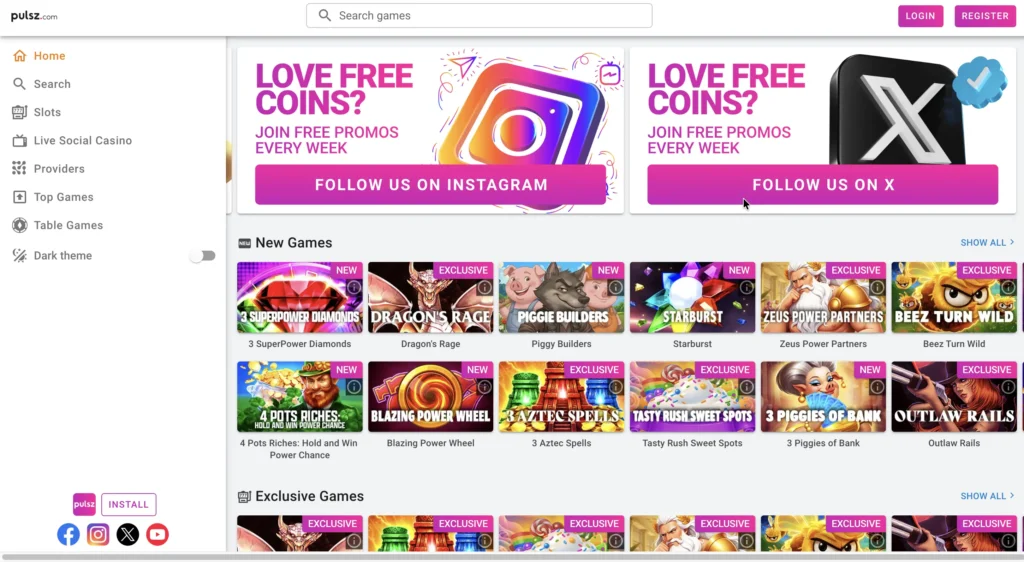
Year established: 2020 | Welcome bonus: 5,000 Gold Coins (GC) + 2.3 SC | Library size: 1,000+
Pulsz operates legally under the US sweepstakes law in 37 states. When it launched, it had around 500 titles, but since then that number has grown to 1,000. Its slot library includes fan-favorite mechanics like Megaways, Hold and Win and Tumbling Reels.
We picked it as one of the best sweepstakes casino for crypto, partly because of its native iOS and Android apps. Most platforms can only be accessed through a web browser, but a native app is always more convenient. Aside from that, daily login rewards and social media giveaways are another plus. The casino site also supports crypto redemptions, adding extra flexibility for players.
Best for: Players who want the best overall experience with native mobile apps and a well-rounded library of casino games.
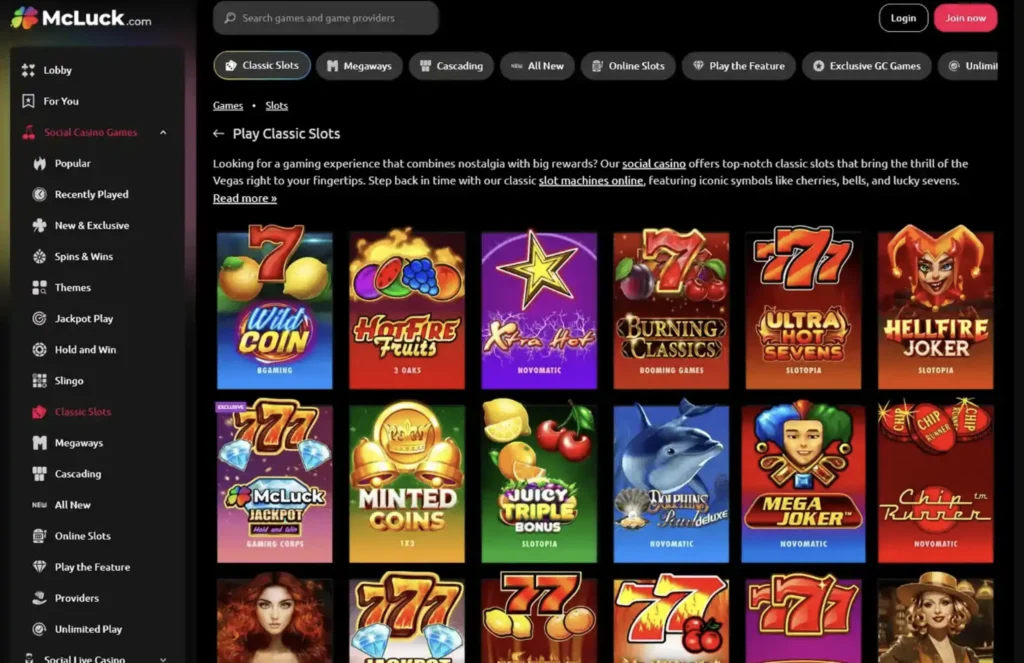
Year established: 2023 | Welcome bonus: 7,500 Gold Coins (GC) + 2.5 SC | Library size: 1,500+
Since launch, McLuck has continued to attract a growing audience in the US market. Although it operates by a “no purchase necessary” policy, players who choose to do so get a highly discounted starter pack. The standout feature of this Bitcoin sweepstakes casino is the McJackpots, a multi-tier progressive jackpot system that can trigger randomly on any spin.
The site has an 8-tier loyalty program that starts from Iron and rises to Black Diamond. The higher you climb, the more specialized benefits you will unlock, including weekly coin boosts and personal VIP hosts. Casinos also like McLuck stand out thanks to a wide variety of casino games.
Best for: Players who want a large game library with a multi-tier progressive jackpot system and an 8-tier loyalty program.
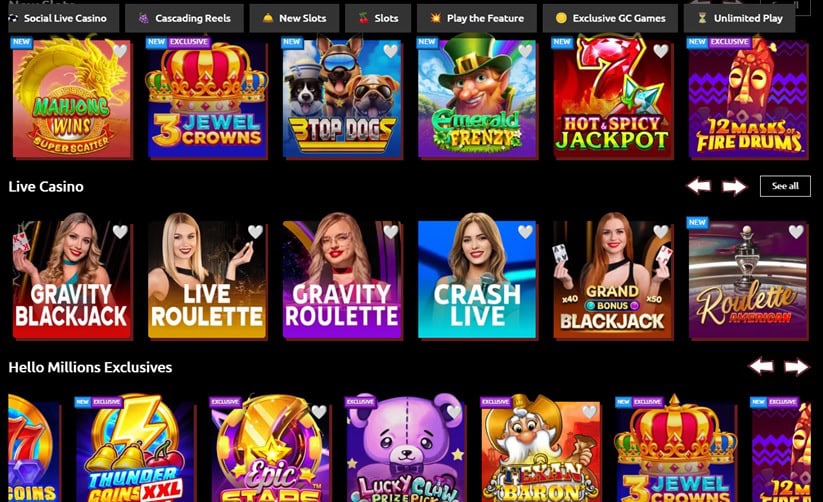
Year established: 2023 | Welcome bonus: 15,000 Gold Coins (GC) + 2.5 SC | Library size: 1,500+
Most crypto sweeps casinos offer primarily RNG slots in their library. Hello Millions deviates from that pattern by giving its members access to table games and live casino. Slots here all come from highly respected software providers like NetEnt, Relax Gaming and BGaming, with a strong average of 97.1% RTP.
The site maintains a lofty public image, with many reviewers on Trustpilot commending the quick crypto redemptions, typically arriving within 1 to 2 days. It also offers a dedicated Android app, but not an iOS app.
Best for: Players who want access to live dealer games and table games alongside slots at a sweeps casino.
 100/100
RTP: 97%
Payout: 0–3 days
Games: 400+
100/100
RTP: 97%
Payout: 0–3 days
Games: 400+
Year established: 2022 | Welcome bonus: 250,000 WOW Coins (WC) + 5 Free SC | Library size: 2,600
Of all the sweepstakes crypto casinos we tested, none could match the welcome package offered by Wow Vegas. New members can claim up to 5 SC, the virtual currency that can be used to play for prize redemption. It is widely accessible and legal in 44 US states, making it one of the best sweepstakes alternatives to traditional online platforms.
Originally concentrating on slots, the site now offers live dealer options from a solid library of casino games. Rather than depending just on in-house titles, they work with big companies to produce premium exclusive slots for their members. Designed as a rolling jackpot wheel, the WOW Jackpot can set off on any spin, increasing participation level.
Best for: Players who want the most lucrative welcome bonus and the widest state accessibility.
 100/100
RTP: 97%
Payout: 0–3 days
Games: 500+
100/100
RTP: 97%
Payout: 0–3 days
Games: 500+

Year established: 2023 | Welcome bonus: 100,000 Crown Coins (CC) + 2 SC | Library size: 700+
Crown Coins offer daily login rewards where your reward grows with your daily login streak. Additionally, this Bitcoin social casino offers weekly challenges and active promotions that help players to stock up on Crown Coins, the virtual currency that is used for playing for fun.
It is also a slot-heavy platform with titles from top-tier software developers like Pragmatic Play, Relax Gaming and Hacksaw Gaming.
Best for: Players who value daily login streaks, weekly challenges and titles from top-tier software developers.
 96/100
RTP: 97%
Payout: 0–3 days
Games: 400+
96/100
RTP: 97%
Payout: 0–3 days
Games: 400+
To help our readers to decide which of the platforms is best for them at a glance, we have designed a comparison table that provides a side-by-side comparison of our top picks.
| Casino | Welcome package | First purchase promo option | Game selection size | Minimum SC redemption |
| Pulsz | 5,000 GC + 2.3 FREE SC | 1,005,000 GC + 77.3 Free SC | 1,000+ | 100 |
| McLuck | 7,500 GC + 2.5 FREE SC | Up to 250 Free SC + 500k GC | 1,500+ | 50 |
| Hello Millions | 120,000 GC + 60 Free SC | Up to 500 SC | 1,500+ | 75 – 100 |
| WOW Vegas | 1.5M WOW Coins + 30-35 SC | 1.75M WOW Coins + 35 SC | 2,000+ | 100 |
| Crown Coins | 100,000 CC + 2 FREE SC | 1.5M CC + 75 SC (200% extra) | 700+ | 50 |
They are social casino sites that operate based on a two-virtual-currency system: Gold Coins (GC) and Sweeps Coins (SC). Digital tokens can be used to make optional purchases and in some cases may appear as part of the prize redemption option. Unlike some players think, cryptocurrency is never used directly for gameplay on sweepstakes casinos. The primary currencies for that remain the GC and SC.
The model separates real money from the gameplay using two distinct types of virtual tokens. Players can toggle their gameplay between the two currencies. GC is used to play for fun. Players can farm GCs for free by completing different activities on these platforms. Alternatively, GC packages can be purchased using accepted cryptocurrencies from your crypto wallet. GC has no monetary value and is used purely for fun.
Players who want to try their hands on prize redemption can switch to playing with SC. This virtual coin cannot be purchased. It is given to players for free through promotions like refer-a-friend. Also, it is usually bundled with GC package purchases as a bonus.
The two virtual currencies perform different actions on a Bitcoin sweepstakes site. The table below highlights their differences at a glance.
| Feature | Gold Coins | Sweepstakes Coins |
| Primary purpose | Social play and entertainment | Entering promotional sweepstakes |
| Monetary value | None (strictly for free play) | Redeemable for cash or gift cards |
| How to acquire | Purchased in bundles or claimed via free bonuses | Never purchased. Only given as a free bonus |
| Transferability | Cannot be traded or cashed out | Can be redeemed after meeting play requirements |
Since crypto sweeps casinos do not accept deposits like regular online casinos, digital tokens function as a tool to make purchases. Unlike traditional payment processors that don’t work on weekends and holidays and often take 3 to 7 business days to process payments, blockchain payments rely on a decentralized network and work around the clock.
Crypto transactions are not limited to fixed hours like traditional transactions using credit cards or bank transfers. Typically, transactions using cryptocurrencies are processed within minutes or a few hours, depending on network congestion.
Also, traditional wire transfers usually attract a flat $25 – $50 as a payment processing fee. With digital tokens, players get a sub-cent processing fee, allowing them to save more on every purchase on Bitcoin sweepstakes platforms.
Transactions using digital tokens lower the amount of personal information that a player shares on a social casino. This lowers the player’s vulnerability if the site is compromised. Blockchain transactions prevent chargebacks or fund freezes and isolate the activities from bank statements.
Digital tokens give players who live in areas where banks are not allowed to handle payments to gaming sites another way to buy GC at sweepstakes casinos with crypto. All you need is a crypto wallet and an internet connection.
The supported digital tokens vary from one platform to another. However, the top five most accepted are Bitcoin, Ethereum, Litecoin, Tether and Dogecoin. The table shows all the supported cryptocurrencies you will find across these platforms in the United States.
| Cryptocurrency | Ticker | Notes |
| Bitcoin | BTC | It is the most widely accepted coin across all platforms |
| Ethereum | ETH | Offers higher transaction speed but with volatile gas fees |
| Litecoin | LTC | Highly popular for lower network fees and quick clearance |
| Tether | USDT | Pegged to fiat USD, preventing price swings |
| USD Coin | USDC | Often used for SC redemption on some platforms |
| Dogecoin | DOGE | Started as a meme coin and became popular for fast transaction processing |
| Ripple | XRP | Offers near-instant transaction speeds |
| Solana | SOL | Offers ultra-low transaction costs |
| Bitcoin Cash | BCH | Has the advantage of lower fees compared to standard BTC |
Purchasing GC using Bitcoin payment or any other digital token follows the same sequence as highlighted below.
Before attempting crypto redemptions, mostly called prize redemption, make sure you have met the site’s rules, including the 1x playthrough requirement and identity verification. Once you have met the requirements, follow the redemption process below.
It can take up to 24 to 48 hours for the operator to approve your request. Once approved, your prize should arrive within minutes to a few hours.
The use of digital tokens on these platforms is usually preferred for speed and security compared to traditional payment methods like credit cards and e-wallets. The table below compares the use of digital tokens with other major payment methods to make it easier for our readers to pick the method that will appeal to them the most.
| Payment method | Crypto | Credit/ Debit card | Bank transfer | PayPal | Skrill |
| Redemption time | Near-instant (minutes to hours) | Varies (1 – 5 business days) | 3 – 5 business days | Within 24 hours | Within 24 hours |
| Fees | No | Varies by card issuer | No | No | No |
| Ease of use | More difficult (especially for punters that are not tech-savvy) | Familiar | Familiar | Moderate | Moderate |
| Support redemption | Yes | Rarely | Yes | Yes | Yes |
| Availability | Minimal | Rare | High | High | Moderate |
| Privacy and anonymity | High | Low | Low | Moderate | Moderate |
| Limits and restrictions | Higher maximum limit | Very low | Very low | Moderate | Moderate |
| Value stability | Volatile | Stable | Stable | Stable | Stable |
One of the ways to pick out the best sweepstakes casino from a list of competing alternatives is to look at the bonuses they offer and the quality of their promotions. Some platforms only end with the welcome offer, which is primarily designed to attract new players to the platform.
However, the best sites always go a step further to keep returning players engaged and happy with recurring promotions. The promotions help returning players to replenish their GC bankroll, so making a purchase becomes a deliberate choice rather than being the only way of getting more Gold Coins.
A welcome offer is a staple in virtually all sweepstakes platforms that accept crypto. It is exclusively reserved for first-time account holders. Players are automatically credited as soon as they complete their account registration. Some sites may require players to complete their email or ID verification before their account is credited.
Welcome bonuses usually consist of thousands of Gold Coins and 1 to 6 SC. Most sites don’t offer a special crypto bonus to players who make purchases using Bitcoin or other digital tokens. Instead, discounts are offered based on your purchase cycle. For example, players completing their first GC package purchase usually get special discounts.
To maintain the policy of “no purchase required,” the platform will always offer returning players alternative ways of earning GC. The most popular alternative is through the daily login streaks.
Players who log into their account once every 24 hours will get a bonus. Every successive login builds your streak and elevates the size of the reward you will earn. Miss one day and your streak resets. Another popular no-purchase bonus is refer-a-friend. When players join the platform using your special referral code or link, you will earn virtual currencies.
Many of the social casinos that operate in the United States don’t accept digital tokens as a payment option. The reason centers on maintaining a distinct identity and staying on the good side of regulators. Below are some of the reasons why many social casinos avoid this payment method.
Most platforms do not charge internal transaction fees for crypto purchases or prize redemptions. However, the punter will always bear the standard blockchain network fees. The time it will take your prize to reflect in your crypto wallet post-approval will depend on the specific token’s network. The table below shows how the gas fees and blockchain confirmation time vary between cryptocurrencies.
| Cryptocurrency | Average network fee | Blockchain confirmation time | Typical casino redemption time |
| Bitcoin | $1.00 – $10.00+ | 10 – 60 minutes | 1 – 6 hours |
| Ethereum | $0.50 – $20.00+ | 1 – 5 minutes | 1 – 6 hours |
| Dogecoin | ~$0.05 – $0.20 | 5 – 20 minutes | 20 minutes – 2 hours |
| Tether | ~$0.10 – $1.00 | 1 – 5 minutes | 5 minutes – 1 hour |
| Solana | <$0.01 | <1 minute | Instant – 1 hour |
| Litecoin | ~$0.01 – $0.10 | 5 – 30 minutes | 10 minutes – 2 hours |
Our team of seasoned experts has a checklist that we use to evaluate online sweepstakes platforms. We assign scores to each of the ranking points. Only platforms that score above 80% make it to our recommendation list. Find our ranking criteria below.
Some of the best social casino platforms have native mobile apps that punters can download from the Play Store or App Store. The apps are not just a watered-down version of the website. Every action that can be performed on the computer can also be completed through the mobile app, including creating an account and purchasing GC packages.
Bitcoin sweepstakes platforms operate in a legal gray area. Though not entirely legal in most U.S. states, the law does not specifically forbid their use. The regulatory terrain is changing, though. Targeting platforms using the dual-currency approach to evade federal law classification as a traditional venue, a fresh wave of regulatory crackdown targets.
According to federal law, a sweepstakes casino that accepts crypto must adhere strictly to the no-purchase-necessary standard. Through daily login rewards and mail-in entries, operators fulfill the required alternative method of entry (AMOE) to remain compliant with U.S. laws. Additionally, while cryptocurrency isn’t placed directly in games, accepting digital tokens lets players purchase optional Gold Coin packages or complete SC prize redemptions.
Since states are permitted to set laws within their borders, some state attorneys general and gaming commissions are actively targeting the loophole exploited by the dual-currency system. Casinos also face varying restrictions depending on jurisdiction. The availability of crypto sweeps casino by state is as follows:
Any legal US casino will clearly disclose that only punters who are 21 years or older will be allowed to create an account. While social casino sites are primarily designed for fun play with zero financial risks, punters chasing real money prizes run the risk of overspending on GC purchases.
The best platforms show their commitment to responsible gaming by providing players with tools to control their spending limits or session reminders that tell the punter how long they have been playing.
On many social casino sites that accept digital tokens, you can only use it for purchasing GC packages. When it comes to crypto redemptions, the options that will be mostly available to you will be bank transfers, gift cards and e-wallets (Skrill and PayPal). This payment method is best for punters who want fast and anonymous transactions at the lowest possible fees.
National Council on Problem Gambling
Contact: 1-800-MY-RESET (1-800-697-3738)
Contact: Refer to the website for local numbers.

Filip Gromovic is a senior slots reviewer here at FreeSlots99 with over five years of experience evaluating the latest drops in the world of iGaming.
Being a slot fan himself, Filip approaches slot ratings just the way we like it – professionally, but also from a player’s standpoint.
That enables him to give his unbiased take on the slot’s features, gameplay and design, while only recommending top-tier releases to our readers.
More info on Filip Gromovic



Having served FreeSlots99 for more than 5 years as a senior content editor and reviewer, Nashon Khamala has extensive knowledge in game slots and iGaming.
His membership in the Editorial Freelancers Association helps him deliver content that reaches both editorial excellence standards and an engaging information level.
By using his expertise in slots games combined with player-focused analysis, Nashon delivers a professional evaluation of slot features and player experiences in his reviews.
More info on Nashon Khamala

Get up to $2500 Welcome bonus!