
What is Dragon Link RTP?
Written by: Filip Gromovic · Reviewed by: Nashon Khamala · Last reviewed: April 2026
Read time: 8 minutes
💡 Quick answer
Dragon Link RTP ranges from 87% on penny machines to 96% on dollar-denomination cabinets. The exact setting is chosen by each individual casino and can vary by property. You can confirm the RTP for any specific machine by pressing the Help or Game Info button on its touchscreen before you play.
Dragon Link is Aristocrat’s flagship Hold & Spin series, found on gaming floors across the United States and Australia. Like all land-based slot machines, its theoretical return to player (RTP) is not a fixed number — it is a configurable value that operators select from a range Aristocrat makes available for each cabinet. Understanding how that range works, how coin level affects it, and how the game’s bonus structure distributes returns helps you set realistic expectations before you sit down.
💡 DRAGON LINK RTP — AT A GLANCE
| Penny machines | 87%–90% RTP |
| Nickel machines | 89%–92% RTP |
| Quarter machines | 90%–93% RTP |
| Dollar machines | 93%–96% RTP |
| High-limit ($5+) | 94%–96% RTP |
The active setting is chosen by the operator — always check the Help screen before you play. Source: According to FreeSlots99 floor observation data.
What is Dragon Link RTP and what range does it cover?
Return to player (RTP) is the percentage of all money wagered that a slot machine is programmed to pay back over a very large number of spins — typically millions. It is a theoretical figure, not a session guarantee. A machine configured at 94% RTP will return $94 for every $100 wagered across its full statistical lifetime; in any single session the result can be dramatically higher or lower due to volatility.
For this title specifically, Aristocrat programs each cabinet with multiple selectable RTP configurations. The confirmed range is 87% to 96%, with the active setting chosen by the operator at installation. Properties in jurisdictions with higher minimum RTP floors — Nevada sets its minimum at around 75%, New Jersey at 83%, though the practical floor sits higher — will typically run machines in the 90–96% band to remain competitive for player retention.
Because the setting lives in software, it can also be adjusted by management over time through an authorised technician, subject to regulatory approval in that jurisdiction.
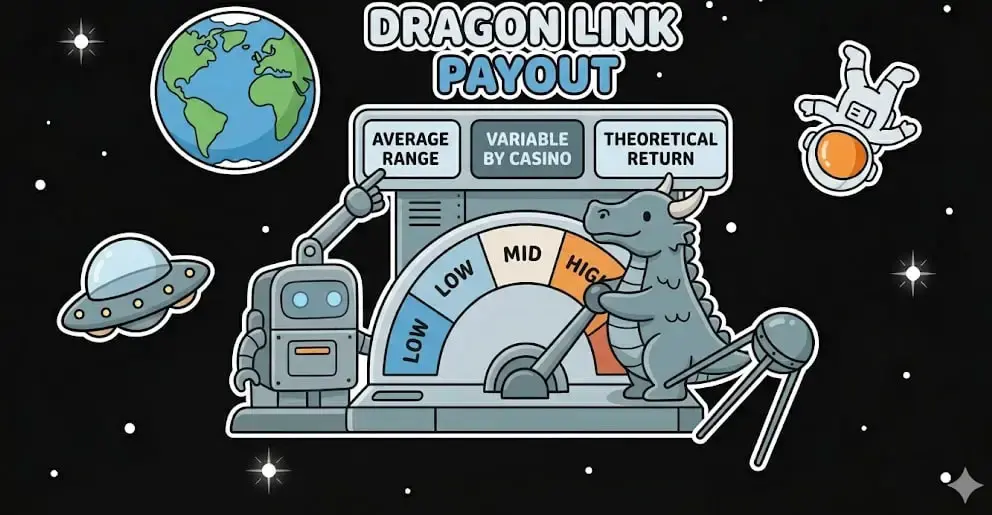
Dragon Link RTP by denomination — full breakdown
Coin level is the single most reliable predictor of which part of the 87–96% range a cabinet will be configured to use. Operators apply higher-paying configurations to premium machines because players at those levels wager more per spin and are more sensitive to perceived value. The table below reflects the typical configurations observed across US gaming floors; exact values vary by property and cannot be confirmed without checking the individual machine’s information screen.
| Denomination | Typical RTP range | Min bet / spin | Grand Jackpot scale | Session bankroll guide |
|---|---|---|---|---|
| 1¢ (penny) | 87%–90% | ~$0.50–$1.00 | ~$500–$2,000 | $50–$100 minimum |
| 5¢ (nickel) | 89%–92% | ~$1.25–$2.50 | ~$2,000–$5,000 | $100–$200 minimum |
| 25¢ (quarter) | 90%–93% | ~$3.75–$6.25 | ~$5,000–$15,000 | $200–$400 minimum |
| $1 (dollar) | 93%–96% | ~$15–$25 | ~$20,000–$50,000 | $500–$1,000 minimum |
| $5+ (high-limit) | 94%–96% | ~$75–$125 | $50,000+ | $2,000+ minimum |
RTP values and prize figures are typical ranges based on publicly observed configurations. The exact value for any specific machine can only be confirmed via that machine’s information screen. Session bankroll guides assume enough spins to trigger the Hold & Spin bonus at least once.
Does a higher denomination always mean better RTP?
In practice, yes — but not automatically. A high-traffic property may run dollar machines at 93% where a boutique venue uses 96% to attract a smaller, discerning player base. The relationship is a strong tendency, not a rule. Always verify on the machine itself.
⚠️ IMPORTANT: HIGH RTP ≠ LOW COST
A $1 Dragon Link at 95% RTP with a $25 minimum spin costs more per hour than a penny machine at 88% spinning at $0.75.
Higher RTP = smaller edge per dollar wagered. It does NOT mean you spend less money per hour.
The tradeoff is equally important: a $1 machine at 95% with a $25 minimum spin costs far more per hour than a penny machine at 88% at $0.75 per spin. Higher RTP means a smaller theoretical edge per dollar wagered — not a lower cost to play.
Dragon Link RTP by variant — Golden Century, Panda Magic, Happy & Prosperous, and others
Dragon Link is a family of games, not a single title. Each variant shares the same core Hold & Spin mechanic and the same 87–96% RTP configuration range, but differs in theme, free-games structure, and bonus multipliers. The RTP range itself is set at the cabinet level by coin level — the variant does not change which band applies. What variants do affect is volatility profile and bonus hit frequency within that return framework.
| Variant | RTP range | Free games | Bonus mechanic notes | Prize tiers |
|---|---|---|---|---|
| Golden Century | 87%–96% | Yes | Symbol removal during free games improves hit frequency | Mini / Minor / Major / Grand |
| Panda Magic | 87%–96% | Yes | Multiplier overlays during Hold & Spin | Mini / Minor / Major / Grand |
| Happy & Prosperous | 87%–96% | Yes | Stacked wilds in free games; Lunar New Year theme | Mini / Minor / Major / Grand |
| Spring Festival | 87%–96% | Yes | Expanding reels during free spins on some configurations | Mini / Minor / Major / Grand |
| Double Lion | 87%–96% | Yes | Dual Hold & Spin screens on linked cabinets | Mini / Minor / Major / Grand |
Note: cannot independently verify exact per-variant RTP sub-configurations from publicly available PAR documentation. The 87–96% range applies to the family as a whole; variants at the same coin level and property will typically share identical settings.
How casinos configure Dragon Link RTP — and why it varies by property
When an operator purchases Dragon Link cabinets, Aristocrat delivers them with a selection of available RTP configurations built into the game software. Gaming managers — not Aristocrat — choose which configuration to activate for each machine. That decision is driven by three factors: regulatory minimums, floor strategy, and player demographics.
What is a PAR sheet and how does Aristocrat document RTP?
A PAR sheet (Probability Accounting Report) is a technical document produced by Aristocrat that details every possible outcome, its probability, and its contribution to overall RTP for a given configuration. PAR sheets are submitted to gaming regulators for approval before a machine can be deployed on a floor.
Operators receive monthly performance reports comparing actual payback against the theoretical RTP in the PAR sheet. If actual returns deviate significantly over a large sample, the property investigates for hardware or software faults. Gaming commissions audit machines on a scheduled basis to verify compliance.
Players cannot obtain PAR sheets directly from Aristocrat. In some jurisdictions — Nevada being the clearest example — gaming commission reports publishing average payback by game type are publicly available. These are floor averages, not machine-level figures.
State minimum RTP floors that affect Dragon Link configurations
Every US jurisdiction that permits slot gaming sets a statutory minimum RTP. Dragon Link’s practical minimum of 87% already sits above most state floors — the minimums matter because they establish the regulatory ceiling operators cannot go below. Actual deployed configurations are typically higher.
| Jurisdiction | Statutory minimum RTP | Notes |
|---|---|---|
| Nevada | 75% | Competitive market drives actual payback well above the floor |
| New Jersey | 83% | Atlantic City properties typically run significantly above this |
| Mississippi | 80% | Gulf Coast and Tunica; floor averages typically 91–93% |
| Michigan | 75% | Detroit commercial venues; tribal compacts vary separately |
| Tribal compacts (varies) | Typically 80%–85% | Set at the compact level; not uniform across states |
Figures sourced from publicly available gaming commission regulations. Verify with the relevant gaming authority for your jurisdiction, as minimums are subject to legislative change.
How to find the RTP on a Dragon Link machine — step by step
Every Dragon Link cabinet is required by its operating jurisdiction to display its configured RTP in an accessible location, typically through the machine’s touchscreen help system.
💡 PRO TIP — CHECK BEFORE YOU INSERT A DOLLAR
You do NOT need to wager to access the RTP screen. Sit at the machine, press Help → Game Info, and read the configured percentage before committing any money.
On multi-denomination cabinets: switch coin level first to confirm the RTP for the tier you intend to play.
If the information screen is not accessible or does not display an RTP figure, ask a floor attendant. In regulated jurisdictions they are obligated to provide this information or direct you to where it is posted.
How Dragon Link’s game features distribute the stated RTP
Knowing the configured RTP figure only tells you the overall target. Just as important is understanding how the machine reaches that figure — because Dragon Link concentrates the vast majority of its theoretical return in bonus features rather than base-game wins. This is what makes it a high-volatility game despite a competitive return percentage.
Hold & Spin: where most of the return is concentrated
The Hold & Spin bonus triggers when six or more Fireball symbols land simultaneously on the reels. The feature locks those symbols in place and awards three respins. Every additional Fireball that lands during the respins resets the counter to three, allowing the feature to run for an extended sequence. Each Fireball carries a credit value, a prize designation, or — if all 15 reel positions are filled — a guaranteed Grand award.
This means that in a dry base-game session you are accumulating very little return. The RTP figure is the blended average across both the dry stretches and the bonus events.
⚠️ KEY INSIGHT: THE DRY SESSION PROBLEM
Dragon Link concentrates the majority of its theoretical return inside the Hold & Spin bonus. During base-game play between bonuses, you are accumulating very little of the stated RTP.
This is not malfunction — it is by design.
The 87–96% RTP is the blended average across both dry stretches AND bonus events combined.
Players who exit before triggering the feature will feel they received far less than the stated return — mathematically, they did in that session, but that is the nature of high-volatility progressive machines.
Progressive prize tiers and their RTP contribution
Dragon Link uses a four-tier local progressive structure: Mini, Minor, Major, and Grand. All four are funded by a percentage of wagers on that specific machine or bank of machines — they are local progressives, not wide-area linked games. Because the prize pool is funded by players on that machine, the contribution is already accounted for within the stated RTP figure. This differs from wide-area networks like Megabucks, where a portion of the return is redirected to a central pool that effectively lowers the base machine return. The stated RTP includes all progressive contributions.
Free Spins and their variant-specific impact
Most Dragon Link variants include a Free Spins bonus triggered by three or more Scatter symbols. Some versions remove the lowest-paying symbols from the reel set during free spins, improving average win per spin. Others add multipliers or expanding wilds. These features improve the feel of the variance without necessarily changing the configured RTP percentage, which is set at the cabinet level before any feature mechanics are applied.
Dragon Link vs Lightning Link RTP — what is actually different?
Lightning Link is Aristocrat’s earlier Hold & Spin series and the predecessor to Dragon Link. Both games share the same core mechanic and the same 87–96% configuration range. From a pure return-rate standpoint, they are equivalent — the difference is in game design, not payout configuration.
| Factor | Dragon Link | Lightning Link |
|---|---|---|
| Manufacturer | Aristocrat | Aristocrat |
| RTP range | 87%–96% | 87%–96% |
| Core mechanic | Hold & Spin (Fireball) | Hold & Spin (Fireball) |
| Prize structure | Mini / Minor / Major / Grand (local) | Mini / Minor / Major / Grand (local) |
| Volatility | High | High |
| Free games | Yes (most variants) | Yes (most variants) |
| Cabinet generation | Newer (2019–present) | Earlier (2016–present) |
| Key difference | Asian-themed variants; often larger Grand prize pools | Broader theme variety; longer floor presence |
The practical takeaway: coin level matters far more than which series you choose. A dollar Dragon Link and a dollar Lightning Link at the same property will almost certainly be running identical configurations.
Dragon Link RTP vs online slot RTP — why land-based machines pay less
If you play slots online, you may be accustomed to advertised RTPs of 96–99%. Dragon Link’s 87–96% range can look unfavourable by comparison. The gap is structural, not a reflection of game quality.
Land-based machines carry costs that online games do not: physical manufacturing, floor space, staff wages, electricity, maintenance, and regulatory infrastructure. Operators factor these into the margin they require from each machine. Online platforms operate with a fraction of these overhead costs, which allows software providers to publish higher theoretical returns and still remain profitable. Many players who prefer the convenience of digital payments use options like Trustly when playing at online casinos, benefiting from both faster cashouts and higher published RTPs.
There is also a regulatory dimension. Online slots are typically certified to a single published RTP visible on the paytable. Land-based machines are certified to a range, with the active setting invisible to players unless they check the information screen. This is why two Dragon Link machines side by side at the same property could theoretically run different configurations — though in practice operators standardise by coin-level bank.
For a full comparison of the highest-paying games available online, see our highest RTP slots guide. For Dragon Link strategy that accounts for this volatility profile, see the Dragon Link strategy guide.
What is the RTP on Dragon Link penny machines?
Penny Dragon Link machines (1¢ coin level) typically operate at 87–90% RTP. This is the lowest tier in the configuration range because penny machines generate lower revenue per spin and operators apply a less generous configuration to maintain the same margin. The Grand prize on penny machines is typically in the $500–$2,000 range rather than the tens of thousands available at dollar coin levels.
💡 PENNY MACHINE REALITY CHECK
87–90% RTP on a penny Dragon Link does NOT mean you lose 10–13 cents per spin.
| Spins per hour | ~500 |
| Avg bet per spin | $0.75 |
| Total action/hour | $375 |
| Expected loss at 90% | ~$37.50/hour |
| Expected loss at 88% | ~$45.00/hour |
RTP applies to total action wagered — not your buy-in. Source: According to FreeSlots99.
Frequently asked questions about Dragon Link RTP
Related Dragon Link guides
- Dragon Link slot strategy — bankroll management across denominations
- How to win on Dragon Link — understanding the Hold & Spin mechanic
- Dragon Link volatility explained — what it means for session length
- Best bet size for Dragon Link — denomination vs bet-per-line tradeoffs
- Highest-paying symbol in Dragon Link — paytable breakdown
- Lightning Link strategy guide — comparison with Dragon Link
- What does RTP mean in slots? — complete explanation
- Highest RTP slots at online casinos in 2026
- Best Litecoin casinos — play slots with crypto
Responsible gambling
Slot machines, including Dragon Link, are designed as entertainment. RTP figures are long-run statistical averages — they do not predict or guarantee outcomes in any individual session. Set a budget before you play and never chase losses. If gambling is causing you distress, free confidential support is available through the National Problem Gambling Helpline: 1-800-522-4700 (US, 24/7). For more guidance, see our responsible gambling guide.
Online Casinos Where You Can Try Dragon Link Slot
 EXCLUSIVE BONUS
 99/100

 RTP: 96%
 Payout: 1–3 days
 Games: 200+
 TOP
TOP
 98/100
RTP: 98%
Payout: 1–3 days
Games: 500+
98/100
RTP: 98%
Payout: 1–3 days
Games: 500+
 95/100
RTP: 97%
Payout: 0–3 days
Games: 400+
95/100
RTP: 97%
Payout: 0–3 days
Games: 400+
 96/100
RTP: 98%
Payout: 1–3 days
Games: 500+
96/100
RTP: 98%
Payout: 1–3 days
Games: 500+
 98/100
RTP: 97%
Payout: 0–3 days
Games: 400+
EXCLUSIVE BONUS
TOP
98/100
RTP: 97%
Payout: 0–3 days
Games: 400+
EXCLUSIVE BONUS
TOP
 97/100
RTP: 99%
Payout: 0–1 days
Games: 2000+
97/100
RTP: 99%
Payout: 0–1 days
Games: 2000+
 NEW
NEW
 96/100
NEW
96/100
NEW
 95/100
RTP: 96.3%
Payout: 1 to 24 hours
Games: 500+
NEW
95/100
RTP: 96.3%
Payout: 1 to 24 hours
Games: 500+
NEW
 95/100
RTP: 96%
Payout: 1–3 days
Games: 500+
95/100
RTP: 96%
Payout: 1–3 days
Games: 500+

Filip Gromovic is a senior slots reviewer here at FreeSlots99 with over five years of experience evaluating the latest drops in the world of iGaming.
Being a slot fan himself, Filip approaches slot ratings just the way we like it – professionally, but also from a player’s standpoint.
That enables him to give his unbiased take on the slot’s features, gameplay and design, while only recommending top-tier releases to our readers.
More info on Filip Gromovic



Having served FreeSlots99 for more than 5 years as a senior content editor and reviewer, Nashon Khamala has extensive knowledge in game slots and iGaming.
His membership in the Editorial Freelancers Association helps him deliver content that reaches both editorial excellence standards and an engaging information level.
By using his expertise in slots games combined with player-focused analysis, Nashon delivers a professional evaluation of slot features and player experiences in his reviews.
More info on Nashon Khamala